Black-breasted Buttonquail
Turnix melanogaster
Silhouette: PhyloPic · PhyloPic
- KingdomAnimalia (Animals)
- PhylumChordata (Chordates)
- ClassAves (Birds)
- OrderCharadriiformes (Shorebirds and Allies)
- FamilyTurnicidae (Buttonquails)
- GenusTurnix (Buttonquail)
- SpeciesTurnix melanogaster (Black-breasted Buttonquail)
About the Black-breasted Buttonquail
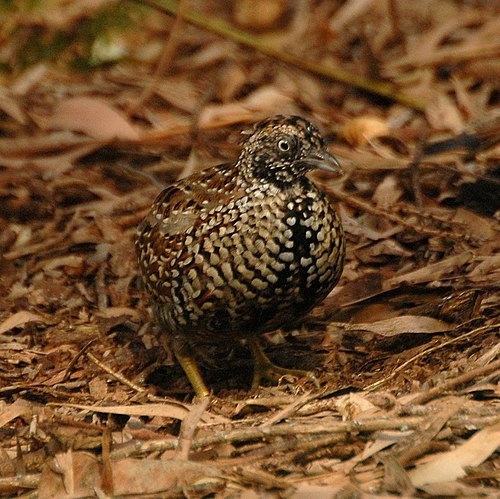
The black-breasted buttonquail (Turnix melanogaster) is a rare buttonquail endemic to eastern Australia. As with other buttonquails, it is unrelated to the true quails. The black-breasted buttonquail is a plump quail-shaped bird 17–19 cm (6.7–7.5 in) in length with predominantly marbled black, rufous, and pale brown plumage, marked prominently with white spots and stripes, and white eyes. Like other buttonquails, the female is larger and more boldly coloured than the male, with a distinctive black head and neck sprinkled with fine white markings. The usual sex roles are reversed, as the female mates with multiple male partners and leaves them to incubate the eggs.
The black-breasted buttonquail is usually found in rainforests, foraging on the ground for invertebrates in large areas of thick leaf litter. Most of its original habitat has been cleared and the remaining populations are fragmented. The species is rated as vulnerable on the International Union for Conservation of Nature (IUCN)'s Red List of Endangered species and is listed as vulnerable under the Environment Protection and Biodiversity Conservation Act 1999. A three-year conservation project has been under way since 2021... Wikipedia →
Recent sightings of Black-breasted Buttonquail in Noosa National Park
LIVEiNaturalistClosest Relatives at Noosa National Park

 Painted Buttonquail
Turnix varius

 Crested Tern
Thalasseus bergii

 Silver Gull
Chroicocephalus novaehollandiae

 Sooty Oystercatcher
Haematopus fuliginosus

 Bush Stone-curlew
Burhinus grallarius

Pied Oystercatcher
Haematopus longirostris

 Caspian Tern
Hydroprogne caspia

 Masked Lapwing
Vanellus miles

 Little Tern
Sternula albifrons

 Common Tern
Sterna hirundo

Bridled Tern
Onychoprion anaethetus

Lesser Crested Tern
Thalasseus bengalensis
Global Distribution
Warmer areas are where this animal is recorded most often.
Parks Where Found
| # | Park | Country | Daily sighting probability |
|---|---|---|---|
| 1 | Noosa National Park | 🇦🇺 Australia |
More parks will be added in future updates.