
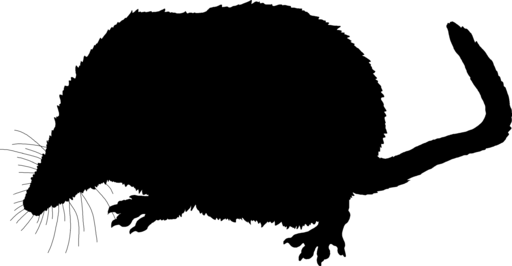
Bendire's Shrew
Sorex bendirii
Silhouette: Becky Barnes · PhyloPic
- KingdomAnimalia (Animals)
- PhylumChordata (Chordates)
- ClassMammalia (Mammals)
- OrderSoricomorpha
- FamilySoricidae (Shrews)
- GenusSorex (Long-tailed Shrews)
- SpeciesSorex bendirii (Bendire's Shrew)
About the Bendire's Shrew
The marsh shrew (Sorex bendirii), also known as the Pacific water shrew, Bendire's water shrew, Bendire's shrew and Jesus shrew, is the largest North American member of the genus Sorex (long-tailed shrews). Primarily covered in dark-brown fur, it is found near aquatic habitats along the Pacific coast from southern British Columbia to northern California. With air trapped in its fur for buoyancy, marsh shrews can run for three to five seconds on top of the water. It measures about 16 cm (6.3 in) in length, including a 7-centimetre (2.8 in)-long tail, and weighs an average of 14.5–16 g (0.51–0.56 oz). The marsh shrew's diet consists mainly of invertebrates, which it hunts on land and in the water. They are rare; their populations are thought to be in decline, and they are considered endangered in parts of their range.
The marsh shrew is the largest member of the genus Sorex in North America, and mammalogist David Nagorsen described it as "an attractive mammal". Its fur is primarily dark brown, and it has a long tail. Although the marsh shrew's fur is usually uniformly dark on its back and abdomen, the abdominal fur of populations (S. b. albiventer) on the Olympic Peninsula... Wikipedia →
Recent sightings of Bendire's Shrew in Olympic National Park
LIVEiNaturalistClosest Relatives at Olympic National Park


Global Distribution
Warmer areas are where this animal is recorded most often.
Parks Where Found
| # | Park | Country | Daily sighting probability |
|---|---|---|---|
| 1 | Olympic National Park | 🇺🇸 United States |
More parks will be added in future updates.