
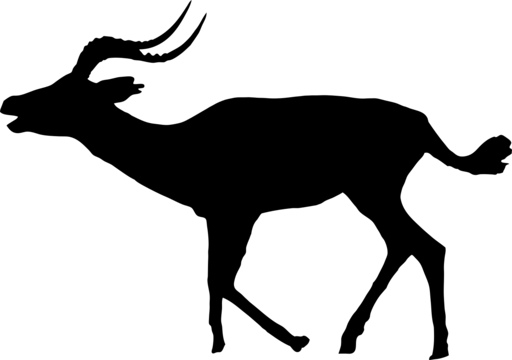
Nilgiri Tahr
Hemitragus hylocrius
Silhouette: [unknown] · PhyloPic
- KingdomAnimalia (Animals)
- PhylumChordata (Chordates)
- ClassMammalia (Mammals)
- OrderArtiodactyla (Even-toed Ungulates and Cetaceans)
- FamilyBovidae (Bovids)
- GenusHemitragus (Himalayan Tahrs)
- SpeciesHemitragus hylocrius (Nilgiri Tahr)
About the Nilgiri Tahr
The Nilgiri tahr (Nilgiritragus hylocrius) is an ungulate that is endemic to the Nilgiri Hills and the southern portion of the Western Ghats in the Indian states of Tamil Nadu and Kerala. It is the only species in the genus Nilgiritragus. The species is classified as endangered in the IUCN Red List. It is the state animal of Tamil Nadu.
The Nilgiri tahr was first described as Capra warryato by John Edward Gray in the 19th century. It was later grouped under the same genus with the Arabian and Himalayan tahrs. However, based on a 2005 phylogenetic, it was reclassified into the news genus Nilgiritragus, and shares a common ancestor with the genus Ovis.
The Nilgiri tahr is a stocky mountain goat with short, coarse yellowish brown fur. The adult males stand about 100 cm (39 in) tall and weigh 80–100 kg (180–220 lb). The males are larger than the females, and have a bristly mane on the back of the neck and a distinctive patch on the saddle. Both sexes have backward-curving horns, which can measure up to 40 cm (16 in). They are agile, and avid climbers, with a keen eye sight.
The Nilgiri tahr is mostly limited to the Nilgiri and Anamalai Hills, with the largest population occurring in the Eravikulam National Park. Key populations also occur in Mukurthi and Grass Hills National Park in Tamil Nadu, with smaller, isolated groups in Ponmudi Hills and Parambikulam in Kerala, and few districts of Tamil Nadu. The species inhabits high-altitude grasslands interspersed with shola forests, and favors rocky cliffs and open plateaus. Historically widespread across the Western Ghats region, the population dropped sharply due to hunting and habitat loss, with only a few hundred left in the wild by the late 20th century. Conservation efforts have increased the population, which was recorded at about 3,122 individuals in 2015, and 2,655 individuals in 2025. Wikipedia →
Recent sightings of Nilgiri Tahr in Periyar National Park
LIVEiNaturalistClosest Relatives at Periyar National Park


Global Distribution
Warmer areas are where this animal is recorded most often.
Parks Where Found
| # | Park | Country | Daily sighting probability |
|---|---|---|---|
| 1 | Eravikulam National Park | 🇮🇳 India | |
| 2 | Periyar National Park | 🇮🇳 India |