


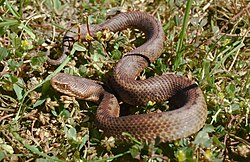

Seoane's Viper
Vipera seoanei
Silhouette: Alex Slavenko · PhyloPic
- KingdomAnimalia (Animals)
- PhylumChordata (Chordates)
- ClassSquamata
- FamilyViperidae (Vipers)
- GenusVipera (Eurasian Vipers)
- SpeciesVipera seoanei (Seoane's Viper)
About the Seoane's Viper
Common names: Baskian viper, Iberian cross adder, Portuguese viper, Seoane's viper. Vipera seoanei is a venomous viper species native to extreme southwestern France and the northern regions of Spain and Portugal. Two subspecies are recognized as being valid, including the nominate race described here.
The specific name, seoanei, is in honor of Spanish naturalist Víctor López Seoane y Pardo-Montenegro. Adults of Vipera seoanei may grow to a total length (tail included) of 75 cm (30 in), but usually less. This is a highly polymorphic species for which four main color-pattern types have been described:
A: well-developed, brown zigzig pattern down the back, very much like V. berus, set against a beige or light-gray ground color. B: roughly twin-striped pattern, with the ground color expressed as two narrow, straight, dorsolateral longitudinal lines along the body. Resembles V. kaznakovi to some degree.
C: uniform brownish morph with no pattern. D: fragmented zigzag pattern (see V. s. cantabrica). Vipera seoanei is found in extreme southwestern France and the northern regions of Spain and Portugal. The type locality is given... Wikipedia →
Recent sightings of Seoane's Viper in Pyrénées National Park
LIVEiNaturalistClosest Relatives at Pyrénées National Park


Global Distribution
Warmer areas are where this animal is recorded most often.
Parks Where Found
| # | Park | Country | Daily sighting probability |
|---|---|---|---|
| 1 | Picos de Europa National Park | 🇪🇸 Spain | |
| 2 | Pyrénées National Park | 🇫🇷 France |
Quick answers
What are the chances of seeing a Seoane's Viper in Pyrénées National Park?
About 10% of wildlife watchers report a Seoane's Viper sighting in Pyrénées National Park, based on 124 verified sightings from GBIF citizen-science data.
When is the best time to see Seoane's Viper in Pyrénées National Park?
October has the highest sighting rate for Seoane's Viper in Pyrénées National Park in our monthly data.