
Beautiful Fruit-Dove
Ptilinopus pulchellus
- KingdomAnimalia (Animals)
- PhylumChordata (Chordates)
- ClassAves (Birds)
- OrderColumbiformes (Pigeons and Doves)
- FamilyColumbidae (Pigeons and Doves)
- GenusPtilinopus (Typical Fruit Doves)
- SpeciesPtilinopus pulchellus (Beautiful Fruit-Dove)
About the Beautiful Fruit-Dove
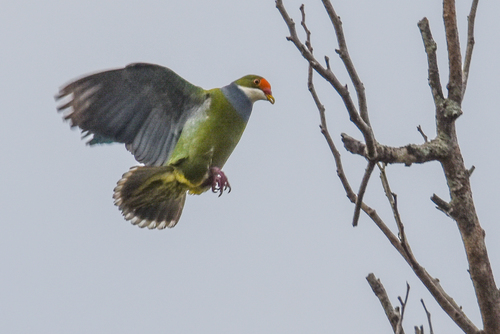
The beautiful fruit dove (Ptilinopus pulchellus), also known as the rose-fronted pigeon or crimson-capped fruit dove, is a small, approximately 19 cm (7+1⁄2 in) long, mainly green fruit dove. It has a red crown, whitish throat, a greenish-yellow bill and purplish-red feet. It has a blue-grey breast and yellowish orange belly, with a reddish purple patch in between. Both sexes are similar.
The beautiful fruit dove is distributed in rainforests of New Guinea and the islands of Batanta, Waigeo, Salawati and Misool in West Papua, Indonesia, primarily in flat terrain. The female usually lays a single white egg.
Its diet consists mainly of various fruits from trees, palms and vines. In the Port Moresby area, birds were found to eat a mixed diet in May. Large Tristiropsis canarioides fruit were taken when available, but the species gets displaced from fruiting trees by larger pigeons such as the collared imperial pigeon (Ducula mullerii). Small Endiandra sp. fruit were very often eaten, but made up only a small quantity of food volume. Other food were Gymnacranthera paniculata and small quantities of Polyalthia sp., Livistona palm fruit, and occasionally pepper (Piper) berries. Despite their small size, they are able to swallow fruits of 5 cm³ volume, which would translate into a diameter of about 2 cm in spherical fruit. (Frith et al. 1976)
Widespread and common throughout its large range, the beautiful fruit dove is evaluated as Least Concern on the IUCN Red List of Threatened Species. Wikipedia →
Closest Relatives at Raja Ampat

Claret-breasted Fruit-Dove
Ptilinopus viridis

Wompoo Fruit Dove
Ptilinopus magnificus
Orange-fronted Fruit-Dove
Ptilinopus aurantiifrons

Pink-spotted Fruit-Dove
Ptilinopus perlatus

Orange-bellied Fruit-Dove
Ptilinopus iozonus

White-breasted Fruit-Dove
Ptilinopus rivoli

Dwarf Fruit-Dove
Ptilinopus nainus

Superb Fruit-Dove
Ptilinopus superbus
Coroneted Fruit-Dove
Ptilinopus coronulatus

Pinon Imperial-Pigeon
Ducula pinon

Spice Imperial-Pigeon
Ducula myristicivora

Sultan's Cuckoo-Dove
Macropygia doreya
Global Distribution
Where this species is recorded worldwide. Restricted to human observations from 2019 onwards — the same kind of record and the same period the probabilities on this page are built from, so collar-tracking studies, camera-trap arrays and museum specimens are excluded. Around Santa Rosa that removes 5,924 GPS fixes from a handful of tagged jaguars.
where this species is recorded (GBIF density — it tracks where observers go, not how likely a sighting is) · parks where it occurs — tap a pin for the sighting probability there
Parks Where Found
| # | Park | Country | Daily sighting probability |
|---|---|---|---|
| 1 | Raja Ampat | 🇮🇩 Indonesia |
More parks will be added in future updates.
Quick answers
What are the chances of seeing a Beautiful Fruit-Dove in Raja Ampat?
About 10% of wildlife watchers report a Beautiful Fruit-Dove sighting in Raja Ampat, based on 158 verified sightings from GBIF citizen-science data.
When is the best time to see Beautiful Fruit-Dove in Raja Ampat?
November has the highest sighting rate for Beautiful Fruit-Dove in Raja Ampat in our monthly data.