
Black-billed Cuckoo-Dove
Macropygia nigrirostris
- KingdomAnimalia (Animals)
- PhylumChordata (Chordates)
- ClassAves (Birds)
- OrderColumbiformes (Pigeons and Doves)
- FamilyColumbidae (Pigeons and Doves)
- GenusMacropygia (Typical Cuckoo-Doves)
- SpeciesMacropygia nigrirostris (Black-billed Cuckoo-Dove)
About the Black-billed Cuckoo-Dove
The bar-tailed cuckoo-dove or black-billed cuckoo-dove (Macropygia nigrirostris) is a species of bird in the family Columbidae. It is native to New Guinea and the Bismarck Archipelago. It is rated as a species of least concern on the International Union for Conservation of Nature Red List of Endangered Species.
The bar-tailed cuckoo-dove measures 29 centimetres (11 in) in length. It has a short, completely black bill. The six central tail feathers are black barred. The central breast feathers are not bifurcated. The male is ruddy-brown, with no clear distinction between the underparts and the upperparts. The female, however, has black barred upperparts. The juvenile is similar to the female, but its tail is barred irregularly.
It is differentiated from other sympatric (other species existing in the same geographic area and thus frequently encountering with it) pigeons other than cuckoo-doves, by its chestnut brown plumage and slender, long tail.
It is native to Papua New Guinea and Indonesia. It inhabits old-growth forests, forest peripheries, and second-growth forests. It also occurs commonly on submontane forests on altitudes of up... Wikipedia →
Closest Relatives at Raja Ampat

Sultan's Cuckoo-Dove
Macropygia doreya

Pinon Imperial-Pigeon
Ducula pinon

Claret-breasted Fruit-Dove
Ptilinopus viridis

Spice Imperial-Pigeon
Ducula myristicivora

Pied Imperial Pigeon
Ducula bicolor

Western Crowned-Pigeon
Goura cristata

Great Cuckoo-Dove
Reinwardtoena reinwardti

Wompoo Fruit Dove
Ptilinopus magnificus

Stephan's Emerald Dove
Chalcophaps stephani
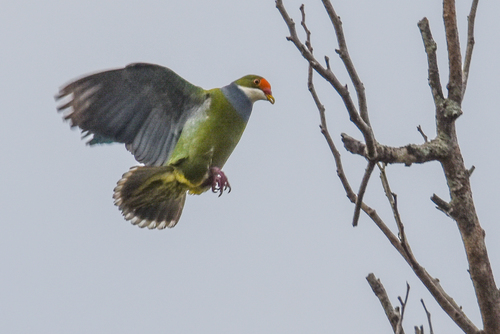
Orange-fronted Fruit-Dove
Ptilinopus aurantiifrons

Beautiful Fruit-Dove
Ptilinopus pulchellus

Pink-spotted Fruit-Dove
Ptilinopus perlatus
Global Distribution
Where this species is recorded worldwide. Restricted to human observations from 2019 onwards — the same kind of record and the same period the probabilities on this page are built from, so collar-tracking studies, camera-trap arrays and museum specimens are excluded. Around Santa Rosa that removes 5,924 GPS fixes from a handful of tagged jaguars.
where this species is recorded (GBIF density — it tracks where observers go, not how likely a sighting is) · parks where it occurs — tap a pin for the sighting probability there
Parks Where Found
| # | Park | Country | Daily sighting probability |
|---|---|---|---|
| 1 | Raja Ampat | 🇮🇩 Indonesia |
More parks will be added in future updates.
Quick answers
What are the chances of seeing a Black-billed Cuckoo-Dove in Raja Ampat?
Under 5% of wildlife watchers report a Black-billed Cuckoo-Dove sighting in Raja Ampat, based on 21 verified sightings from GBIF citizen-science data.
When is the best time to see Black-billed Cuckoo-Dove in Raja Ampat?
February has the highest sighting rate for Black-billed Cuckoo-Dove in Raja Ampat in our monthly data.