
Crocodile Monitor
Varanus salvadorii
- KingdomAnimalia (Animals)
- PhylumChordata (Chordates)
- ClassSquamata
- FamilyVaranidae (Monitor Lizards)
- GenusVaranus (Monitor Lizards)
- SpeciesVaranus salvadorii (Crocodile Monitor)
About the Crocodile Monitor
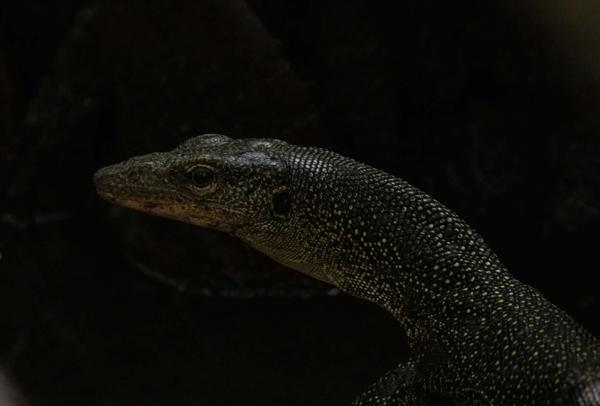
The crocodile monitor (Varanus salvadorii), also known as the Papuan monitor or Salvadori's monitor, is a species of monitor lizard endemic to New Guinea. It is the largest monitor lizard in New Guinea and is one of the longest lizards, verified at up to 255 cm (100 in). Its tail is exceptionally long, with some specimens having been claimed to exceed the length of the Komodo dragon, however less massive.
The crocodile monitor is an arboreal lizard with a dark green body marked with bands of yellowish spots. It has a characteristic blunt snout and a very long prehensile tail. It lives among the mangrove swamps and coastal rainforests of the southeastern part of New Guinea, feeding opportunistically on everything from birds and small mammals to eggs, other reptiles, amphibians and carrion. Its large, backwards-curving teeth are better adapted than those of most monitors for seizing fast-moving prey. Like all monitors, it has anatomical features that enable it to breathe more easily when running than other lizards, and is sometimes considered one of the most agile monitor species.
Crocodile monitors are threatened by deforestation and poaching, and are protected by CITES. Little is known of its reproduction and development, as it is difficult to breed in captivity. Attempts at captive breeding have been mostly unsuccessful. In New Guinea, the lizard is sometimes hunted and skinned by tribesmen to make drums. It is described as an evil spirit that "climbs trees, walks upright, breathes fire, and kills men", yet the local people maintain that it gives warnings if crocodiles are nearby. Wikipedia →
Closest Relatives at Raja Ampat

Mangrove Monitor
Varanus indicus

Blue-spotted Tree Monitor
Varanus macraei

Peach-throated Monitor
Varanus jobiensis

Emerald Monitor
Varanus prasinus

Bluetail Monitor
Varanus doreanus

Golden-spotted Tree Monitor
Varanus boehmei

Reisinger's Tree Monitor
Varanus reisingeri
Rainer Günther’s Monitor
Varanus rainerguentheri
Global Distribution
Where this species is recorded worldwide. Restricted to human observations from 2019 onwards — the same kind of record and the same period the probabilities on this page are built from, so collar-tracking studies, camera-trap arrays and museum specimens are excluded. Around Santa Rosa that removes 5,924 GPS fixes from a handful of tagged jaguars.
where this species is recorded (GBIF density — it tracks where observers go, not how likely a sighting is) · parks where it occurs — tap a pin for the sighting probability there
Parks Where Found
| # | Park | Country | Daily sighting probability |
|---|---|---|---|
| 1 | Raja Ampat | 🇮🇩 Indonesia |
More parks will be added in future updates.
Quick answers
What are the chances of seeing a Crocodile Monitor in Raja Ampat?
About 10% of wildlife watchers report a Crocodile Monitor sighting in Raja Ampat, based on 6 verified sightings from GBIF citizen-science data.
When is the best time to see Crocodile Monitor in Raja Ampat?
February has the highest sighting rate for Crocodile Monitor in Raja Ampat in our monthly data.