


Double-eyed Fig-Parrot
Cyclopsitta diophthalma
- KingdomAnimalia (Animals)
- PhylumChordata (Chordates)
- ClassAves (Birds)
- OrderPsittaciformes (Parrots)
- FamilyPsittacidae (New World and African Parrots)
- GenusCyclopsitta (Lesser Fig Parrots)
- SpeciesCyclopsitta diophthalma (Double-eyed Fig-Parrot)
About the Double-eyed Fig-Parrot
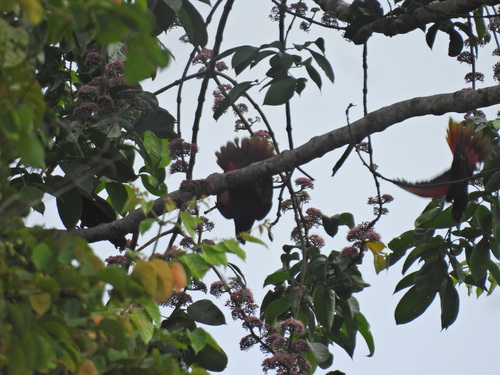
The double-eyed fig parrot (Cyclopsitta diophthalma), also known as the blue-faced fig parrot, red-faced fig parrot, dwarf fig parrot, and the two-eyed fig parrot, primarily inhabits forests on New Guinea and nearby islands, but is also found in isolated communities along the tropical Australian coast, east of the Great Dividing Range. With an average total length of about 14 cm (5+1⁄2 in), it is the smallest parrot in Australia.
Most subspecies of the double-eyed fig parrot are sexually dimorphic, with males having more red (less silvery and blue) to the face than the females. It is predominantly green with a very short tail, a disproportionately large head and bill, and red and blue facial markings. Its name is derived from a blue spot on the lores, which in New Guinean birds is roughly the same size as the eyes.
Although assessed as of Least Concern by the IUCN, certain subspecies are under threat. Coxen's fig parrot (C. d. coxeni) is of one Australia's rarest and least known birds, having been recorded on fewer than 200 occasions since being described by Gould in 1866. It is classified as Endangered in Queensland (Nature Conservation Act 1992), New South Wales (New South Wales Threatened Species Conservation Act 1995), and also nationally in Australia (Environment Protection and Biodiversity Conservation Act 1999) as it has declined due, at least in part, to the clearing of lowland subtropical rainforest over its range. Wikipedia →
Closest Relatives at Raja Ampat

Red-sided Eclectus
Eclectus roratus

Red-cheeked Parrot
Geoffroyus geoffroyi

Palm Cockatoo
Probosciger aterrimus

Sulphur-crested Cockatoo
Cacatua galerita

Black-capped Lory
Lorius lory

Coconut Lorikeet
Trichoglossus haematodus

Great-billed Parrot
Tanygnathus megalorynchos

Yellow-capped Pygmy-Parrot
Micropsitta keiensis

Moluccan King-Parrot
Alisterus amboinensis

Chattering Lory
Lorius garrulus

Salmon-crested Cockatoo
Cacatua moluccensis
Black Lory
Chalcopsitta atra
Global Distribution
Where this species is recorded worldwide. Restricted to human observations from 2019 onwards — the same kind of record and the same period the probabilities on this page are built from, so collar-tracking studies, camera-trap arrays and museum specimens are excluded. Around Santa Rosa that removes 5,924 GPS fixes from a handful of tagged jaguars.
where this species is recorded (GBIF density — it tracks where observers go, not how likely a sighting is) · parks where it occurs — tap a pin for the sighting probability there
Parks Where Found
| # | Park | Country | Daily sighting probability |
|---|---|---|---|
| 1 | Daintree National Park | 🇦🇺 Australia | |
| 2 | Raja Ampat | 🇮🇩 Indonesia |
Quick answers
What are the chances of seeing a Double-eyed Fig-Parrot in Raja Ampat?
About 10% of wildlife watchers report a Double-eyed Fig-Parrot sighting in Raja Ampat, based on 76 verified sightings from GBIF citizen-science data.
When is the best time to see Double-eyed Fig-Parrot in Raja Ampat?
January has the highest sighting rate for Double-eyed Fig-Parrot in Raja Ampat in our monthly data.