
Far Eastern Curlew
Numenius madagascariensis
- KingdomAnimalia (Animals)
- PhylumChordata (Chordates)
- ClassAves (Birds)
- OrderCharadriiformes (Shorebirds and Allies)
- FamilyScolopacidae (Sandpipers and Allies)
- GenusNumenius (Curlews)
- SpeciesNumenius madagascariensis (Far Eastern Curlew)
About the Far Eastern Curlew
The Far Eastern curlew (Numenius madagascariensis) is a large wader most similar in appearance to the long-billed curlew, but slightly larger. It is mostly brown, differentiated from other curlews by its plain, unpatterned brown underwing, and brown rump. It is not only the largest curlew but probably the world's largest sandpiper, at 60–66 cm (24–26 in) in length and 110 cm (43 in) across the wings. The weight is 390–1,350 g (0.86–2.98 lb), which is equalled by the Eurasian curlew; females are on average about 100 g heavier than males. The extremely long bill, at 12.8–20.1 cm (5.0–7.9 in) in length, rivals the bill size of the closely related long-billed curlew as the longest bill for a sandpiper. It overlaps in range with the eastern subspecies of the Eurasian curlew Numenius arquata orientalis, from which it is most easily told by its brown rump and lower back, rather than white.
In 1760 the French zoologist Mathurin Jacques Brisson included a description of the Far Eastern curlew in his Ornithologie based on a specimen. He used the French name Le courly de Madagascar and the Latin Numenius madagascariensis. Although Brisson coined Latin names, these do not conform... Wikipedia →
Closest Relatives at Raja Ampat

Whimbrel
Numenius phaeopus

Little Curlew
Numenius minutus
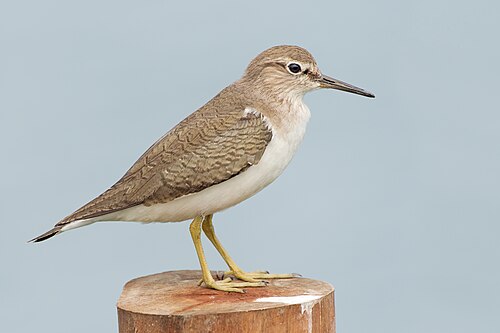
Common Sandpiper
Actitis hypoleucos

Red-necked Phalarope
Phalaropus lobatus

Grey-tailed Tattler
Tringa brevipes

Great Knot
Calidris tenuirostris

Curlew Sandpiper
Calidris ferruginea

Little Stint
Calidris minuta

Common Greenshank
Tringa nebularia

Bar-tailed Godwit
Limosa lapponica

Wood Sandpiper
Tringa glareola

Sharp-tailed Sandpiper
Calidris acuminata
Global Distribution
Where this species is recorded worldwide. Restricted to human observations from 2019 onwards — the same kind of record and the same period the probabilities on this page are built from, so collar-tracking studies, camera-trap arrays and museum specimens are excluded. Around Santa Rosa that removes 5,924 GPS fixes from a handful of tagged jaguars.
where this species is recorded (GBIF density — it tracks where observers go, not how likely a sighting is) · parks where it occurs — tap a pin for the sighting probability there
Parks Where Found
| # | Park | Country | Daily sighting probability |
|---|---|---|---|
| 1 | Bako National Park | 🇲🇾 Malaysia | |
| 2 | Ningaloo Marine Park | 🇦🇺 Australia | |
| 3 | Daintree National Park | 🇦🇺 Australia | |
| 4 | Royal National Park | 🇦🇺 Australia | |
| 5 | Cape Range | 🇦🇺 Australia | |
| 6 | Wilsons Promontory National Park | 🇦🇺 Australia | |
| 7 | Bali Barat National Park | 🇮🇩 Indonesia | |
| 8 | Kakadu National Park | 🇦🇺 Australia | |
| 9 | Raja Ampat | 🇮🇩 Indonesia | |
| 10 | Taroko National Park | 🇹🇼 Taiwan |