
Great Cuckoo-Dove
Reinwardtoena reinwardti
- KingdomAnimalia (Animals)
- PhylumChordata (Chordates)
- ClassAves (Birds)
- OrderColumbiformes (Pigeons and Doves)
- FamilyColumbidae (Pigeons and Doves)
- GenusReinwardtoena (Greater Cuckoo-Doves)
- SpeciesReinwardtoena reinwardti (Great Cuckoo-Dove)
About the Great Cuckoo-Dove
The great cuckoo-dove (Reinwardtoena reinwardti) is a species of bird in the pigeon family, Columbidae. First described by the Dutch zoologist Coenraad Jacob Temminck in 1824, it is found on New Guinea, several surrounding islands, and Wallacea, where it mainly inhabits primary forest and the forest edge. It is a large, distinctive pigeon, with a length of 47.5–52.5 cm (18.7–20.7 in) and a weight of 208–305 g (7.3–10.8 oz). In adults, the head, neck, and breast are whitish or blue-grey, the underparts are pale bluish-grey, the upperparts are chestnut-brown, and the outer wings are black. Females differ from males in having more yellowish irises and duller orbital skin. Juveniles are mainly dull grey-brown, with dirty-white throats and bellies.
The species feeds on fruit and seeds. It is usually seen alone or in pairs, but forms flocks with other frugivorous birds at fruit trees. It is known to defend fruiting shrubs it is feeding on, an uncommon foraging behaviour among birds. Breeding occurs throughout the year and varies in different parts of its range, seemingly peaking from October to December on New Guinea. Nests are flat or slightly concave platforms made of sticks, moss, roots, and ferns, and contain a single white egg. The species is classified as being of least concern by the International Union for Conservation of Nature due to its sufficiently large range and stable population. Wikipedia →
Closest Relatives at Raja Ampat

Pinon Imperial-Pigeon
Ducula pinon

Claret-breasted Fruit-Dove
Ptilinopus viridis

Spice Imperial-Pigeon
Ducula myristicivora

Sultan's Cuckoo-Dove
Macropygia doreya

Pied Imperial Pigeon
Ducula bicolor

Western Crowned-Pigeon
Goura cristata

Wompoo Fruit Dove
Ptilinopus magnificus

Stephan's Emerald Dove
Chalcophaps stephani
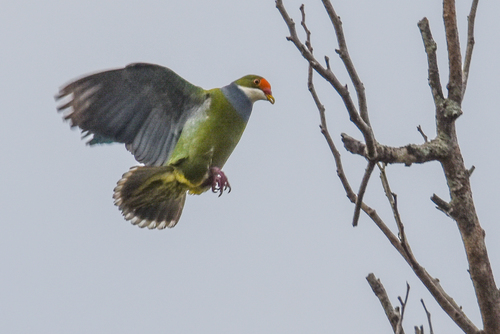
Orange-fronted Fruit-Dove
Ptilinopus aurantiifrons

Beautiful Fruit-Dove
Ptilinopus pulchellus

Pink-spotted Fruit-Dove
Ptilinopus perlatus

Orange-bellied Fruit-Dove
Ptilinopus iozonus
Global Distribution
Where this species is recorded worldwide. Restricted to human observations from 2019 onwards — the same kind of record and the same period the probabilities on this page are built from, so collar-tracking studies, camera-trap arrays and museum specimens are excluded. Around Santa Rosa that removes 5,924 GPS fixes from a handful of tagged jaguars.
where this species is recorded (GBIF density — it tracks where observers go, not how likely a sighting is) · parks where it occurs — tap a pin for the sighting probability there
Parks Where Found
| # | Park | Country | Daily sighting probability |
|---|---|---|---|
| 1 | Raja Ampat | 🇮🇩 Indonesia |
More parks will be added in future updates.
Quick answers
What are the chances of seeing a Great Cuckoo-Dove in Raja Ampat?
About 20% of wildlife watchers report a Great Cuckoo-Dove sighting in Raja Ampat, based on 244 verified sightings from GBIF citizen-science data.
When is the best time to see Great Cuckoo-Dove in Raja Ampat?
August has the highest sighting rate for Great Cuckoo-Dove in Raja Ampat in our monthly data.