
Great Knot
Calidris tenuirostris
- KingdomAnimalia (Animals)
- PhylumChordata (Chordates)
- ClassAves (Birds)
- OrderCharadriiformes (Shorebirds and Allies)
- FamilyScolopacidae (Sandpipers and Allies)
- GenusCalidris (Calidris Sandpipers)
- SpeciesCalidris tenuirostris (Great Knot)
About the Great Knot
The great knot (Calidris tenuirostris) is a medium-sized wader. It is one of the largest species in the genus Calidris. It is a migratory bird which breeds in eastern Siberia, Russia, and flies to southern Asia and Australia in the northern winter.
Within the genus Calidris the great knot is most closely related to the surfbird (Calidris virgata). The genus name is from Ancient Greek kalidris or skalidris, a term used by Aristotle for some grey-coloured waterside birds. The specific tenuirostris is from Latin tenuis "slender" and rostrum "bill".
Their breeding habitat is tundra in northeast Siberia, Russia. They nest on the ground laying about four eggs in a ground scrape. They are strongly migratory wintering on coasts in southern Asia through to Australia. This species forms enormous flocks in winter.
The species is also recorded in summer in low numbers in western Alaska, United States in most years, and in winter in small numbers west to Pakistan, Oman, and the United Arab Emirates. It has occurred as a vagrant in Great Britain, Morocco, New Zealand, British Columbia in Canada, and in the lower 48 states of the USA in Oregon, West Virginia, and... Wikipedia →
Closest Relatives at Raja Ampat

Curlew Sandpiper
Calidris ferruginea

Little Stint
Calidris minuta

Sharp-tailed Sandpiper
Calidris acuminata

Red-necked Stint
Calidris ruficollis

Long-toed Stint
Calidris subminuta

Sanderling
Calidris alba
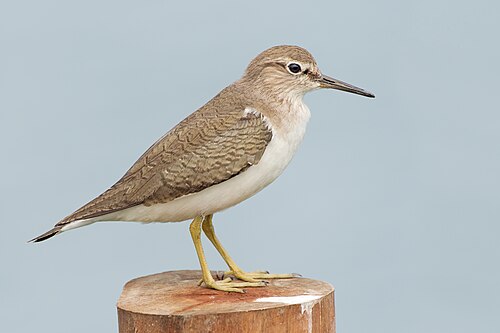
Common Sandpiper
Actitis hypoleucos

Whimbrel
Numenius phaeopus

Red-necked Phalarope
Phalaropus lobatus

Grey-tailed Tattler
Tringa brevipes

Common Greenshank
Tringa nebularia

Bar-tailed Godwit
Limosa lapponica
Global Distribution
Where this species is recorded worldwide. Restricted to human observations from 2019 onwards — the same kind of record and the same period the probabilities on this page are built from, so collar-tracking studies, camera-trap arrays and museum specimens are excluded. Around Santa Rosa that removes 5,924 GPS fixes from a handful of tagged jaguars.
where this species is recorded (GBIF density — it tracks where observers go, not how likely a sighting is) · parks where it occurs — tap a pin for the sighting probability there
Parks Where Found
| # | Park | Country | Daily sighting probability |
|---|---|---|---|
| 1 | Ningaloo Marine Park | 🇦🇺 Australia | |
| 2 | Cape Range | 🇦🇺 Australia | |
| 3 | Daintree National Park | 🇦🇺 Australia | |
| 4 | Raja Ampat | 🇮🇩 Indonesia | |
| 5 | Taroko National Park | 🇹🇼 Taiwan | |
| 6 | Sundarbans National Park | 🇮🇳 India |