
Little Curlew
Numenius minutus
- KingdomAnimalia (Animals)
- PhylumChordata (Chordates)
- ClassAves (Birds)
- OrderCharadriiformes (Shorebirds and Allies)
- FamilyScolopacidae (Sandpipers and Allies)
- GenusNumenius (Curlews)
- SpeciesNumenius minutus (Little Curlew)
About the Little Curlew
The little curlew (Numenius minutus) is a wader in the large bird family Scolopacidae. It is a very small curlew, which breeds in the far north of Siberia. It is closely related to the North American Eskimo curlew. The word "curlew" is imitative of the Eurasian curlew's call, but may have been influenced by the Old French corliu, "messenger", from courir, "to run". It was first recorded in 1377 in Langland's Piers Plowman. The genus name Numenius is from Ancient Greek noumenios, a bird mentioned by Hesychius. It is associated with the curlews because it appears to be derived from neos, "new", and mene, "moon", referring to the crescent-shaped bill. The species name is from Latin minutus, "small".
It is mainly greyish-brown, including the underwings, with a white belly, and a short, for a curlew, curved bill. It has a head pattern like a Eurasian whimbrel, with crown and superciliary stripes. The call is a repetitive whistle. It is the smallest species of curlew with an average length of 28–31 cm (11–12 in), an average wingspan of 68–71 cm (27–28 in) and an average weight of 175 grams (6.2 oz).
This is a strongly migratory species,... Wikipedia →
Closest Relatives at Raja Ampat

Whimbrel
Numenius phaeopus

Far Eastern Curlew
Numenius madagascariensis
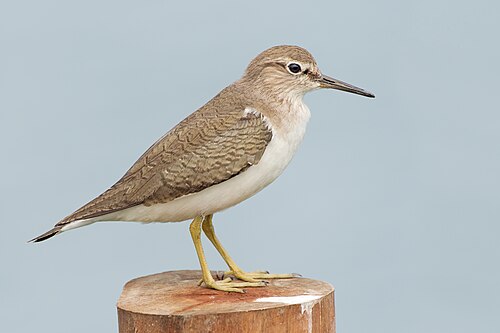
Common Sandpiper
Actitis hypoleucos

Red-necked Phalarope
Phalaropus lobatus

Grey-tailed Tattler
Tringa brevipes

Great Knot
Calidris tenuirostris

Curlew Sandpiper
Calidris ferruginea

Little Stint
Calidris minuta

Common Greenshank
Tringa nebularia

Bar-tailed Godwit
Limosa lapponica

Wood Sandpiper
Tringa glareola

Sharp-tailed Sandpiper
Calidris acuminata
Global Distribution
Where this species is recorded worldwide. Restricted to human observations from 2019 onwards — the same kind of record and the same period the probabilities on this page are built from, so collar-tracking studies, camera-trap arrays and museum specimens are excluded. Around Santa Rosa that removes 5,924 GPS fixes from a handful of tagged jaguars.
where this species is recorded (GBIF density — it tracks where observers go, not how likely a sighting is) · parks where it occurs — tap a pin for the sighting probability there
Parks Where Found
| # | Park | Country | Daily sighting probability |
|---|---|---|---|
| 1 | Ningaloo Marine Park | 🇦🇺 Australia | |
| 2 | Kakadu National Park | 🇦🇺 Australia | |
| 3 | Daintree National Park | 🇦🇺 Australia | |
| 4 | Cape Range | 🇦🇺 Australia | |
| 5 | Gobi Gurvansaikhan National Park | 🇲🇳 Mongolia | |
| 6 | Raja Ampat | 🇮🇩 Indonesia |