
Long-toed Stint
Calidris subminuta
- KingdomAnimalia (Animals)
- PhylumChordata (Chordates)
- ClassAves (Birds)
- OrderCharadriiformes (Shorebirds and Allies)
- FamilyScolopacidae (Sandpipers and Allies)
- GenusCalidris (Calidris Sandpipers)
- SpeciesCalidris subminuta (Long-toed Stint)
About the Long-toed Stint
The long-toed stint (Calidris subminuta) is a small wader. The genus name is from Ancient Greek kalidris or skalidris, a term used by Aristotle for some grey-coloured waterside birds. The specific subminuta is from Latin sub, "near to" and minuta, "small" from its similarity to the little stint, Calidris minuta.
Within the genus Calidris the long-toed stint is most closely related to Temminck's stint (Calidris temminckii). It breeds across northern Asia and is strongly migratory, wintering in south and south east Asia and Australasia. It occurs in western Europe only as a very rare vagrant.
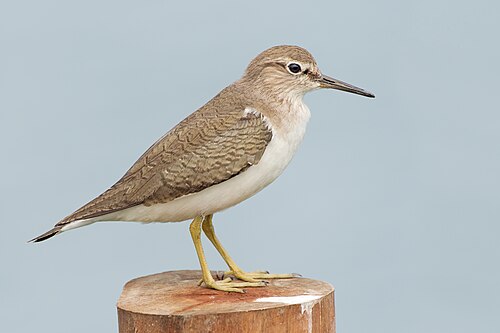
This bird has yellowish legs and a short thin dark bill. Breeding adults are a rich brown with darker feather centres above and white underneath. They have a light line above the eye and a brown crown. In winter, long-toed stints are grey above. The juveniles are brightly patterned above with rufous colouration and white mantle stripes.
This bird can be difficult to distinguish from other similar tiny waders which are known collectively as "peeps" or "stints". In particular, the long-toed stint is very similar to its North American counterpart, the least sandpiper. It differs from that species in its more slender, longer-necked appearance, longer toes, somewhat brighter colours, and weaker wingbar.
These birds forage on mudflats, picking up food by sight, sometimes by probing. They mainly eat small crustaceans, insects and snails. Little is known of the breeding habits of this species, although it nests on the ground, and the male has a display flight. Wikipedia →
Closest Relatives at Raja Ampat

Great Knot
Calidris tenuirostris

Curlew Sandpiper
Calidris ferruginea

Little Stint
Calidris minuta

Sharp-tailed Sandpiper
Calidris acuminata

Red-necked Stint
Calidris ruficollis

Sanderling
Calidris alba
Common Sandpiper
Actitis hypoleucos

Whimbrel
Numenius phaeopus

Red-necked Phalarope
Phalaropus lobatus

Grey-tailed Tattler
Tringa brevipes

Common Greenshank
Tringa nebularia

Bar-tailed Godwit
Limosa lapponica
Global Distribution
Where this species is recorded worldwide. Restricted to human observations from 2019 onwards — the same kind of record and the same period the probabilities on this page are built from, so collar-tracking studies, camera-trap arrays and museum specimens are excluded. Around Santa Rosa that removes 5,924 GPS fixes from a handful of tagged jaguars.
where this species is recorded (GBIF density — it tracks where observers go, not how likely a sighting is) · parks where it occurs — tap a pin for the sighting probability there
Parks Where Found
| # | Park | Country | Daily sighting probability |
|---|---|---|---|
| 1 | Bali Barat National Park | 🇮🇩 Indonesia | |
| 2 | Gobi Gurvansaikhan National Park | 🇲🇳 Mongolia | |
| 3 | Wilpattu National Park | 🇱🇰 Sri Lanka | |
| 4 | Raja Ampat | 🇮🇩 Indonesia | |
| 5 | Khao Yai National Park | 🇹🇭 Thailand | |
| 6 | Yala National Park | 🇱🇰 Sri Lanka | |
| 7 | Kinabatangan Wildlife Sanctuary | 🇲🇾 Malaysia |