
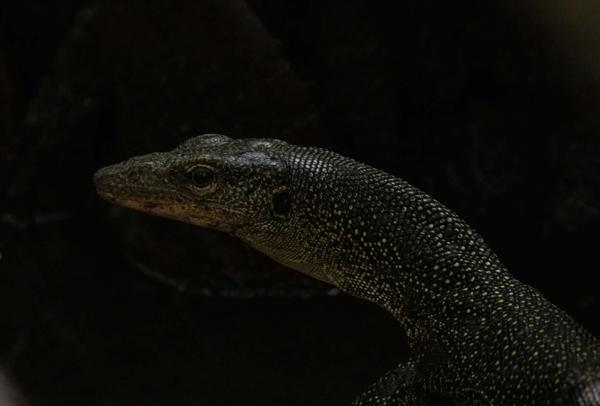
Mangrove Monitor
Varanus indicus
- KingdomAnimalia (Animals)
- PhylumChordata (Chordates)
- ClassSquamata
- FamilyVaranidae (Monitor Lizards)
- GenusVaranus (Monitor Lizards)
- SpeciesVaranus indicus (Mangrove Monitor)
About the Mangrove Monitor
The mangrove monitor, mangrove goanna, or Western Pacific monitor lizard (Varanus indicus) is a member of the monitor lizard family with a large distribution from northern Australia and New Guinea to the Moluccas and Solomon Islands. It grows to lengths of 3.5 to 4 ft (1.1 to 1.2 m). It is also known as wbl yb in the Kalam language of Papua New Guinea.
The mangrove monitor was first described by the French herpetologist François Marie Daudin in 1802. Daudin's original holotype of a subadult specimen was collected on Ambon, Indonesia, and has since disappeared from the museum in Paris. Daudin's original name for the species was Tupinambis indicus, an appellation it would carry for 100 years until being renamed as a Varanus.
The generic name Varanus is derived from the Arabic word waral (ورل), which translates to English as "monitor". Its specific name, indicus, is Latin for the country of India, but in this instance it relates to Indonesia or the East Indies, where the animal was first described.
Due to its large geographic range, V. indicus is considered a cryptic species complex of at least four species: Varanus indicus, Varanus doreanus, Varanus spinulosus, and Varanus... Wikipedia →
Closest Relatives at Raja Ampat

Blue-spotted Tree Monitor
Varanus macraei

Peach-throated Monitor
Varanus jobiensis

Emerald Monitor
Varanus prasinus

Crocodile Monitor
Varanus salvadorii

Bluetail Monitor
Varanus doreanus

Golden-spotted Tree Monitor
Varanus boehmei

Reisinger's Tree Monitor
Varanus reisingeri
Rainer Günther’s Monitor
Varanus rainerguentheri
Global Distribution
Where this species is recorded worldwide. Restricted to human observations from 2019 onwards — the same kind of record and the same period the probabilities on this page are built from, so collar-tracking studies, camera-trap arrays and museum specimens are excluded. Around Santa Rosa that removes 5,924 GPS fixes from a handful of tagged jaguars.
where this species is recorded (GBIF density — it tracks where observers go, not how likely a sighting is) · parks where it occurs — tap a pin for the sighting probability there
Parks Where Found
| # | Park | Country | Daily sighting probability |
|---|---|---|---|
| 1 | Raja Ampat | 🇮🇩 Indonesia |
More parks will be added in future updates.
Quick answers
What are the chances of seeing a Mangrove Monitor in Raja Ampat?
About 40% of wildlife watchers report a Mangrove Monitor sighting in Raja Ampat, based on 95 verified sightings from GBIF citizen-science data.
When is the best time to see Mangrove Monitor in Raja Ampat?
May has the highest sighting rate for Mangrove Monitor in Raja Ampat in our monthly data.