


Munguna
Mobula alfredi
- KingdomAnimalia (Animals)
- PhylumChordata (Chordates)
- ClassElasmobranchii
- OrderMyliobatiformes (Stingrays)
- FamilyMyliobatidae (Eagle Rays)
- GenusMobula (Devil Rays)
- SpeciesMobula alfredi (Munguna)
About the Munguna
The reef manta ray or hāhālua (Mobula alfredi) is a species of ray in the family Mobulidae, one of the largest rays in the world. Among generally recognized species, it is the third-largest species of ray, surpassed by the Giant oceanic manta ray and the Atlantic manta ray.
The species was described in 1868 by Gerard Krefft, the director of the Australian Museum. He named it M. alfredi in honor of Alfred, Duke of Edinburgh, the first member of the British royal family to visit Australia. It was originally described as part of the genus Manta but in 2017 was changed, along with the rest of the mantas, to be included as part of the genus Mobula.
Reef manta rays are typically 3 to 3.5 m (9.8 to 11.5 ft) in disc width, with a maximum size of about 5.5 m (18 ft). For a long time included in M. birostris, the status of the reef manta ray as a separate species was only confirmed in 2009. The reef manta ray is found widely in the tropical and subtropical Indo-Pacific, but with a few records from the tropical East Atlantic and none from the West Atlantic or East Pacific. Compared to the giant oceanic manta ray, the reef manta ray tends to be found in shallower, more coastal habitats, but local migrations are sometimes reported.
Mobula birostris is similar in appearance to Mobula alfredi and the two species may be confused as their distribution overlaps. However, there are distinguishing features. Wikipedia →
Closest Relatives at Raja Ampat

Oceanic Manta Ray
Mobula birostris

Ox Ray
Mobula kuhlii

Longhorned Pygmy Devil Ray
Mobula eregoodoo

White-spotted Eagle Ray
Aetobatus ocellatus

Ornate Eagle Ray
Aetomylaeus vespertilio
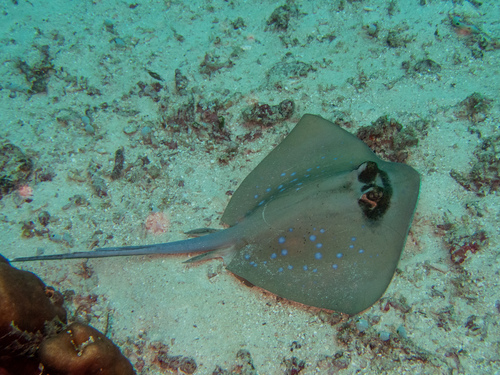
Moluccan Bluespotted Maskray
Neotrygon moluccensis

Reef ray
Taeniura lymma

Mangrove Ray
Urogymnus granulatus

Blotched Fantail Ray
Taeniurops meyeni

Oriental Bluespotted Maskray
Neotrygon orientale

Reticulate Whipray
Himantura uarnak

Pink Whipray
Pateobatis fai
Global Distribution
Where this species is recorded worldwide. Restricted to human observations from 2019 onwards — the same kind of record and the same period the probabilities on this page are built from, so collar-tracking studies, camera-trap arrays and museum specimens are excluded. Around Santa Rosa that removes 5,924 GPS fixes from a handful of tagged jaguars.
where this species is recorded (GBIF density — it tracks where observers go, not how likely a sighting is) · parks where it occurs — tap a pin for the sighting probability there
Parks Where Found
| # | Park | Country | Daily sighting probability |
|---|---|---|---|
| 1 | Raja Ampat | 🇮🇩 Indonesia | |
| 2 | Ningaloo Marine Park | 🇦🇺 Australia |
Quick answers
What are the chances of seeing a Munguna in Raja Ampat?
About 60% of wildlife watchers report a Munguna sighting in Raja Ampat, based on 105 verified sightings from GBIF citizen-science data.
When is the best time to see Munguna in Raja Ampat?
January has the highest sighting rate for Munguna in Raja Ampat in our monthly data.