
Oriental Bluespotted Maskray
Neotrygon orientale
- KingdomAnimalia (Animals)
- PhylumChordata (Chordates)
- ClassElasmobranchii
- OrderMyliobatiformes (Stingrays)
- FamilyDasyatidae (Whiptail Stingrays)
- GenusNeotrygon (Maskrays)
- SpeciesNeotrygon orientale (Oriental Bluespotted Maskray)
About the Oriental Bluespotted Maskray
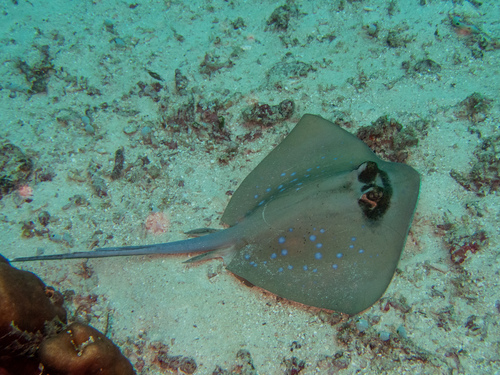
Neotrygon orientalis, the Oriental bluespotted maskray, is a type of whiptail stingray found mainly in Indonesia, Malaysia, Philippines, and Taiwan. It has also caused the description of a new diphyllidean species, the Echinobothrium ivanovae species, has been described from N. orientalis.
This species can be distinguished from its closest congener (Neotrygon kuhlii) through several characteristics, such as abruptly angular pectoral apices, dusky ventral tail fold with darker edge, small mouth, pronounced mask-like markings, and covered with moderate-sized blue spots and dark peppery spots. The maximum size for the male specimens is 38 cm disc width (DW).It is often confused with the newly described Neotrygon yakkoei and the Neotrygon khulli complex. The high morphological similarities among the species make species of the Khulli complex hard to identify. Phylogenetically, N. orientalis and N. varidens form a sister clade to the species N. indica, which may have a common ancestor in the Plio-Pleistocene.
This species distribution range encompasses the regions of Sumatra, Java, Kalimantan, and Sulawesi in Indonesia; Sabah and Sarawak in... Wikipedia →
Closest Relatives at Raja Ampat
Moluccan Bluespotted Maskray
Neotrygon moluccensis

Reef ray
Taeniura lymma

Mangrove Ray
Urogymnus granulatus

Blotched Fantail Ray
Taeniurops meyeni

Reticulate Whipray
Himantura uarnak

Pink Whipray
Pateobatis fai

Thorny Ray
Urogymnus asperrimus

Broad Cowtail Stingray
Pastinachus ater

Dragon stingray
Pateobatis jenkinsii

Munguna
Mobula alfredi

Oceanic Manta Ray
Mobula birostris

Ox Ray
Mobula kuhlii
Global Distribution
Where this species is recorded worldwide. Restricted to human observations from 2019 onwards — the same kind of record and the same period the probabilities on this page are built from, so collar-tracking studies, camera-trap arrays and museum specimens are excluded. Around Santa Rosa that removes 5,924 GPS fixes from a handful of tagged jaguars.
where this species is recorded (GBIF density — it tracks where observers go, not how likely a sighting is) · parks where it occurs — tap a pin for the sighting probability there
Parks Where Found
| # | Park | Country | Daily sighting probability |
|---|---|---|---|
| 1 | Tangkoko Nature Reserve | 🇮🇩 Indonesia | |
| 2 | Raja Ampat | 🇮🇩 Indonesia |