
Ox Ray
Mobula kuhlii
- KingdomAnimalia (Animals)
- PhylumChordata (Chordates)
- ClassElasmobranchii
- OrderMyliobatiformes (Stingrays)
- FamilyMyliobatidae (Eagle Rays)
- GenusMobula (Devil Rays)
- SpeciesMobula kuhlii (Ox Ray)
About the Ox Ray
Mobula kuhlii, the shortfin devil ray, is a species of ray in the family Mobulidae. It is endemic to the Indian Ocean and central-west Pacific Ocean. It ranges from South Africa, Mozambique, Tanzania and the Seychelles in the west to the Philippines and Indonesia in the east, and southward to the northern coast of Australia.
The shortfin devil ray is a small eagle ray growing to a maximum width of 120 cm (47 in) and a weight of 30 kilograms (66 lb). It is flattened horizontally with a wide central disc and the head is short with small cephalic fins. The large pectoral fins have curved tips and the dorsal fin has a white tip. The tail is not tipped with a spine and is shorter than the body. The dorsal surface of this fish is brown and does not bear any placoid scales, and the ventral surface is white.
The shortfin devil ray feeds on plankton and possibly also on small fish and squid. It gathers its food by swimming with its mouth open and passing the water over its gill rakers which filter out the food particles. It is an ovoviviparous fish and has the lowest rate of reproduction of any of the elasmobranchs. A litter usually consists of a single pup and... Wikipedia →
Closest Relatives at Raja Ampat

Munguna
Mobula alfredi

Oceanic Manta Ray
Mobula birostris

Longhorned Pygmy Devil Ray
Mobula eregoodoo

White-spotted Eagle Ray
Aetobatus ocellatus

Ornate Eagle Ray
Aetomylaeus vespertilio
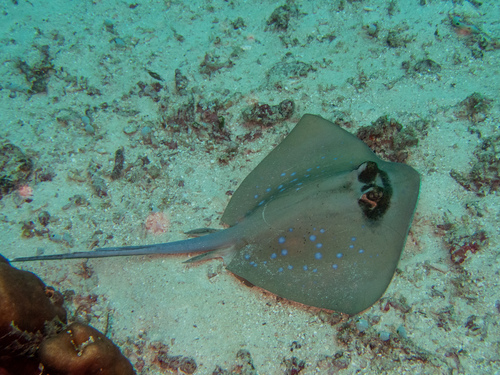
Moluccan Bluespotted Maskray
Neotrygon moluccensis

Reef ray
Taeniura lymma

Mangrove Ray
Urogymnus granulatus

Blotched Fantail Ray
Taeniurops meyeni

Oriental Bluespotted Maskray
Neotrygon orientale

Reticulate Whipray
Himantura uarnak

Pink Whipray
Pateobatis fai
Global Distribution
Where this species is recorded worldwide. Restricted to human observations from 2019 onwards — the same kind of record and the same period the probabilities on this page are built from, so collar-tracking studies, camera-trap arrays and museum specimens are excluded. Around Santa Rosa that removes 5,924 GPS fixes from a handful of tagged jaguars.
where this species is recorded (GBIF density — it tracks where observers go, not how likely a sighting is) · parks where it occurs — tap a pin for the sighting probability there
Parks Where Found
| # | Park | Country | Daily sighting probability |
|---|---|---|---|
| 1 | Raja Ampat | 🇮🇩 Indonesia |
More parks will be added in future updates.
Quick answers
What are the chances of seeing a Ox Ray in Raja Ampat?
About 20% of wildlife watchers report a Ox Ray sighting in Raja Ampat, based on 9 verified sightings from GBIF citizen-science data.
When is the best time to see Ox Ray in Raja Ampat?
March has the highest sighting rate for Ox Ray in Raja Ampat in our monthly data.