
Palm Cockatoo
Probosciger aterrimus
- KingdomAnimalia (Animals)
- PhylumChordata (Chordates)
- ClassAves (Birds)
- OrderPsittaciformes (Parrots)
- FamilyPsittacidae (New World and African Parrots)
- GenusProbosciger (Palm Cockatoos)
- SpeciesProbosciger aterrimus (Palm Cockatoo)
About the Palm Cockatoo
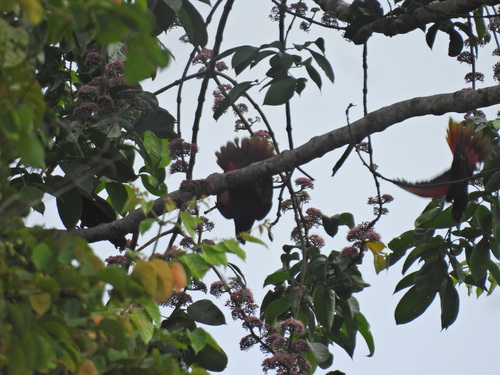
The palm cockatoo (Probosciger aterrimus), also known as the goliath cockatoo or great black cockatoo, is a large, smoky-grey/black parrot of the cockatoo family native to New Guinea, the Aru Islands and the Cape York Peninsula in Queensland, Australia. It has a crest of long feathers atop its head, with a very large and strong, sharply-hooked black beak (with which it can easily open nuts and seeds), and prominent bright-red cheek patches.
The palm cockatoo was formally described in 1788 by naturalist Johann Friedrich Gmelin in his revised and expanded edition of Carl Linnaeus's Systema Naturae, in which he classified the bird with other parrots in the genus Psittacus and coined the binomial name Psittacus aterrimus. Gmelin based his description on the "black cockatoo" that had been described and illustrated in 1764 by English naturalist George Edwards. Joan Gideon Loten had provided Edwards with a drawing of the bird by the Sri Lankan artist Pieter Cornelis de Bevere; the original drawing by de Bere is in the collection of the Natural History Museum, London.
The palm cockatoo is, now, the only species within the genus Probosciger that was introduced by Heinrich Kuhl... Wikipedia →
Closest Relatives at Raja Ampat

Red-sided Eclectus
Eclectus roratus

Red-cheeked Parrot
Geoffroyus geoffroyi

Sulphur-crested Cockatoo
Cacatua galerita

Black-capped Lory
Lorius lory

Coconut Lorikeet
Trichoglossus haematodus

Great-billed Parrot
Tanygnathus megalorynchos

Yellow-capped Pygmy-Parrot
Micropsitta keiensis

Double-eyed Fig-Parrot
Cyclopsitta diophthalma

Moluccan King-Parrot
Alisterus amboinensis

Chattering Lory
Lorius garrulus

Salmon-crested Cockatoo
Cacatua moluccensis
Black Lory
Chalcopsitta atra
Global Distribution
Where this species is recorded worldwide. Restricted to human observations from 2019 onwards — the same kind of record and the same period the probabilities on this page are built from, so collar-tracking studies, camera-trap arrays and museum specimens are excluded. Around Santa Rosa that removes 5,924 GPS fixes from a handful of tagged jaguars.
where this species is recorded (GBIF density — it tracks where observers go, not how likely a sighting is) · parks where it occurs — tap a pin for the sighting probability there
Parks Where Found
| # | Park | Country | Daily sighting probability |
|---|---|---|---|
| 1 | Raja Ampat | 🇮🇩 Indonesia |
More parks will be added in future updates.
Quick answers
What are the chances of seeing a Palm Cockatoo in Raja Ampat?
About 40% of wildlife watchers report a Palm Cockatoo sighting in Raja Ampat, based on 72 verified sightings from GBIF citizen-science data.
When is the best time to see Palm Cockatoo in Raja Ampat?
June has the highest sighting rate for Palm Cockatoo in Raja Ampat in our monthly data.