
Pink Whipray
Pateobatis fai
- KingdomAnimalia (Animals)
- PhylumChordata (Chordates)
- ClassElasmobranchii
- OrderMyliobatiformes (Stingrays)
- FamilyDasyatidae (Whiptail Stingrays)
- GenusPateobatis
- SpeciesPateobatis fai (Pink Whipray)
About the Pink Whipray
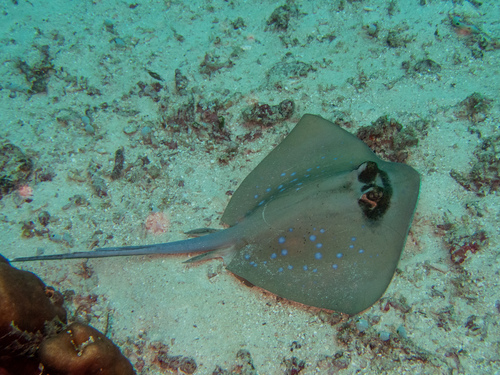
The pink whipray (Pateobatis fai) is a species of stingray in the family Dasyatidae, with a wide but ill-defined distribution in the tropical Indo-Pacific from southern Africa to Polynesia. It is a bottom dweller that generally inhabits shallow water under 70 m (230 ft) deep, in sandy areas associated with coral reefs. Individuals exhibit a high degree of fidelity to particular locations. The pink whipray has a diamond-shaped pectoral fin disc wider than long, with a broad-angled snout and a very long, whip-like tail without fin folds. It has only a few small thorns on its back and is uniform brownish to grayish pink in color, becoming much darker past the tail sting. This large ray can reach 1.8 m (5.9 ft) across and over 5 m (16 ft) long.
Gregarious in nature, the pink whipray has been known to form large active and resting aggregations, and associate with other large ray species. It preys mainly on prawns, but also consumes other benthic invertebrates and bony fishes. This species is aplacental viviparous, in which the unborn young are nourished by histotroph ("uterine milk") produced by the mother. Across much of its range, substantial numbers of pink whiprays are caught incidentally by a variety of fishing gear and marketed for meat, skin, and cartilage. It is also of importance to ecotourism, being attracted to visitors with bait. In 2009, the International Union for Conservation of Nature (IUCN) had listed this species as Least Concern, due to its wide distribution that includes relatively protected areas, such as northern Australia. However, its population is likely declining under heavy fishing pressure, and since 2016 has been assessed as Vulnerable. Wikipedia →
Closest Relatives at Raja Ampat

Dragon stingray
Pateobatis jenkinsii
Moluccan Bluespotted Maskray
Neotrygon moluccensis

Reef ray
Taeniura lymma

Mangrove Ray
Urogymnus granulatus

Blotched Fantail Ray
Taeniurops meyeni

Oriental Bluespotted Maskray
Neotrygon orientale

Reticulate Whipray
Himantura uarnak

Thorny Ray
Urogymnus asperrimus

Broad Cowtail Stingray
Pastinachus ater

Munguna
Mobula alfredi

Oceanic Manta Ray
Mobula birostris

Ox Ray
Mobula kuhlii
Global Distribution
Where this species is recorded worldwide. Restricted to human observations from 2019 onwards — the same kind of record and the same period the probabilities on this page are built from, so collar-tracking studies, camera-trap arrays and museum specimens are excluded. Around Santa Rosa that removes 5,924 GPS fixes from a handful of tagged jaguars.
where this species is recorded (GBIF density — it tracks where observers go, not how likely a sighting is) · parks where it occurs — tap a pin for the sighting probability there
Parks Where Found
| # | Park | Country | Daily sighting probability |
|---|---|---|---|
| 1 | Ningaloo Marine Park | 🇦🇺 Australia | |
| 2 | Raja Ampat | 🇮🇩 Indonesia |