
Red-sided Eclectus
Eclectus roratus
- KingdomAnimalia (Animals)
- PhylumChordata (Chordates)
- ClassAves (Birds)
- OrderPsittaciformes (Parrots)
- FamilyPsittacidae (New World and African Parrots)
- GenusEclectus (Eclectus Parrots)
- SpeciesEclectus roratus (Red-sided Eclectus)
About the Red-sided Eclectus
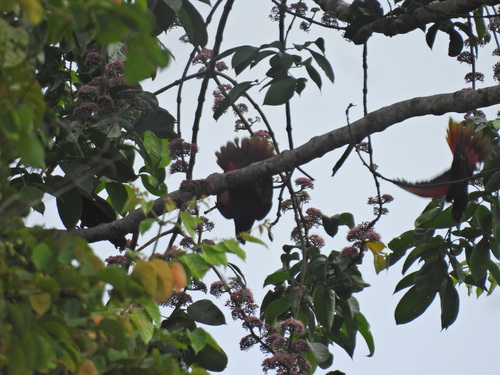
The Moluccan eclectus (Eclectus roratus) is a parrot native to the Maluku Islands (Moluccas). It is unusual in the parrot order for its extreme sexual dimorphism of the colours of the plumage; the male having a mostly bright emerald green plumage and the female a mostly bright red and purple/blue plumage. Joseph Forshaw, in his book Parrots of the World, noted that the first European ornithologists to see eclectus parrots thought they were of two distinct species. Large populations of this parrot remain, and they are sometimes considered pests for eating fruit off trees. Some populations restricted to relatively small islands are comparably rare. Their bright feathers are also used by native tribespeople in New Guinea as decorations.
Ornithologists usually classify the Moluccan eclectus as a member of tribe Psittaculini in the family Psittacidae of order Psittaciformes. However, some recent thoughts indicate a great deal of commonality between the eclectus parrots and the Lorini tribe.
Sir D'Arcy Wentworth Thompson noted similarities in the skull were noted between the eclectus parrots and members of the genus Geoffroyus, specifically in the auditory meatus and the... Wikipedia →
Closest Relatives at Raja Ampat

Red-cheeked Parrot
Geoffroyus geoffroyi

Palm Cockatoo
Probosciger aterrimus

Sulphur-crested Cockatoo
Cacatua galerita

Black-capped Lory
Lorius lory

Coconut Lorikeet
Trichoglossus haematodus

Great-billed Parrot
Tanygnathus megalorynchos

Yellow-capped Pygmy-Parrot
Micropsitta keiensis

Double-eyed Fig-Parrot
Cyclopsitta diophthalma

Moluccan King-Parrot
Alisterus amboinensis

Chattering Lory
Lorius garrulus

Salmon-crested Cockatoo
Cacatua moluccensis
Black Lory
Chalcopsitta atra
Global Distribution
Where this species is recorded worldwide. Restricted to human observations from 2019 onwards — the same kind of record and the same period the probabilities on this page are built from, so collar-tracking studies, camera-trap arrays and museum specimens are excluded. Around Santa Rosa that removes 5,924 GPS fixes from a handful of tagged jaguars.
where this species is recorded (GBIF density — it tracks where observers go, not how likely a sighting is) · parks where it occurs — tap a pin for the sighting probability there
Parks Where Found
| # | Park | Country | Daily sighting probability |
|---|---|---|---|
| 1 | Raja Ampat | 🇮🇩 Indonesia | |
| 2 | Daintree National Park | 🇦🇺 Australia | |
| 3 | Bali Barat National Park | 🇮🇩 Indonesia |
Quick answers
What are the chances of seeing a Red-sided Eclectus in Raja Ampat?
About 60% of wildlife watchers report a Red-sided Eclectus sighting in Raja Ampat, based on 1,354 verified sightings from GBIF citizen-science data.
When is the best time to see Red-sided Eclectus in Raja Ampat?
July has the highest sighting rate for Red-sided Eclectus in Raja Ampat in our monthly data.