
Reticulate Whipray
Himantura uarnak
- KingdomAnimalia (Animals)
- PhylumChordata (Chordates)
- ClassElasmobranchii
- OrderMyliobatiformes (Stingrays)
- FamilyDasyatidae (Whiptail Stingrays)
- GenusHimantura (Whiprays)
- SpeciesHimantura uarnak (Reticulate Whipray)
About the Reticulate Whipray
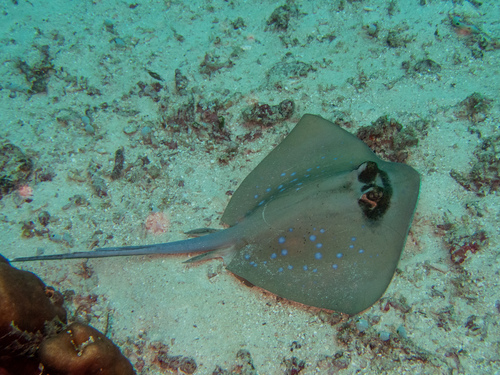
The reticulate whipray or honeycomb stingray (Himantura uarnak) is a species of stingray in the family Dasyatidae. It inhabits coastal waters in the western Indian Ocean including the Red Sea, Natal and the Arabian Sea; also a Lessepsian transmigrant in the eastern Mediterranean. A large species reaching 2 m (6.6 ft) in width, the reticulate whipray has a diamond-shaped pectoral fin disc and an extremely long tail without fin folds. Both its common and scientific names refer to its ornate dorsal color pattern of many small, close-set dark spots or reticulations on a lighter background. However, the reticulate whipray is only one of several large spotted stingrays in the Indo-Pacific which, coupled with the variability of its coloration with age and locality, has resulted in a great deal of taxonomic confusion.
Often encountered resting on the bottom during daytime, the reticulate whipray is a predator of bottom-dwelling invertebrates and bony fishes. Like other stingrays, it is aplacental viviparous, with the developing embryos nourished at first by yolk and later by histotroph ("uterine milk"). Females bear litters of up to five pups in summer, following a gestation period of a year. The reticulate whipray is fished in parts of the Indian Ocean for meat, skin, cartilage, and other purposes. It is highly susceptible to population depletion because of its large size, inshore habits, and low reproductive rate, and is additionally threatened by extensive habitat degradation. Consequently, the International Union for Conservation of Nature (IUCN) has assessed this species as Endangered. Wikipedia →
Closest Relatives at Raja Ampat
Moluccan Bluespotted Maskray
Neotrygon moluccensis

Reef ray
Taeniura lymma

Mangrove Ray
Urogymnus granulatus

Blotched Fantail Ray
Taeniurops meyeni

Oriental Bluespotted Maskray
Neotrygon orientale

Pink Whipray
Pateobatis fai

Thorny Ray
Urogymnus asperrimus

Broad Cowtail Stingray
Pastinachus ater

Dragon stingray
Pateobatis jenkinsii

Munguna
Mobula alfredi

Oceanic Manta Ray
Mobula birostris

Ox Ray
Mobula kuhlii
Global Distribution
Where this species is recorded worldwide. Restricted to human observations from 2019 onwards — the same kind of record and the same period the probabilities on this page are built from, so collar-tracking studies, camera-trap arrays and museum specimens are excluded. Around Santa Rosa that removes 5,924 GPS fixes from a handful of tagged jaguars.
where this species is recorded (GBIF density — it tracks where observers go, not how likely a sighting is) · parks where it occurs — tap a pin for the sighting probability there
Parks Where Found
| # | Park | Country | Daily sighting probability |
|---|---|---|---|
| 1 | Raja Ampat | 🇮🇩 Indonesia | |
| 2 | Ningaloo Marine Park | 🇦🇺 Australia |