
Stephan's Emerald Dove
Chalcophaps stephani
- KingdomAnimalia (Animals)
- PhylumChordata (Chordates)
- ClassAves (Birds)
- OrderColumbiformes (Pigeons and Doves)
- FamilyColumbidae (Pigeons and Doves)
- GenusChalcophaps (Emerald Doves)
- SpeciesChalcophaps stephani (Stephan's Emerald Dove)
About the Stephan's Emerald Dove
Stephan's emerald dove, also known as Stephan's dove (Chalcophaps stephani), is a species of bird in the pigeon family Columbidae. Formally described by the French zoologist Jacques Pucheran in 1853, the dove is named after Étienne Jacquinot, the father of the French naturalist Honoré Jacquinot. The emerald dove has a large range in Indonesia and Melanesia, stretching from Sulawesi and Taliabu east through most of lowland New Guinea and its satellite islands to the Admiralty Islands, Bismarck Archipelago, and Solomon Islands. It is a forest-dwelling species that is usually seen in inland rainforests, although it can inhabit other wooded habitats like scrubby coconut plantations and coastal forests if competing species like the common emerald dove are absent. Stephan's emerald doves migrate locally in response to local climactic conditions and food availability.
The dove is mainly frugivorous, foraging on the forest floor for fallen fruits, seeds, and occasionally insects and other invertebrates. In New Guinea, the breeding season last from January to May during the wet season. The nest is a flimsy structure made of twigs, containing two cream or pale yellowish eggs. Stephan's emerald is listed as being of least concern on the IUCN Red List due to its large range and stable population. The species is fairly common throughout its range and is especially common on smaller islands in the Bismarck Archipelago. Wikipedia →
Closest Relatives at Raja Ampat

Asian Emerald Dove
Chalcophaps indica

Pinon Imperial-Pigeon
Ducula pinon

Claret-breasted Fruit-Dove
Ptilinopus viridis

Spice Imperial-Pigeon
Ducula myristicivora

Sultan's Cuckoo-Dove
Macropygia doreya

Pied Imperial Pigeon
Ducula bicolor

Western Crowned-Pigeon
Goura cristata

Great Cuckoo-Dove
Reinwardtoena reinwardti

Wompoo Fruit Dove
Ptilinopus magnificus
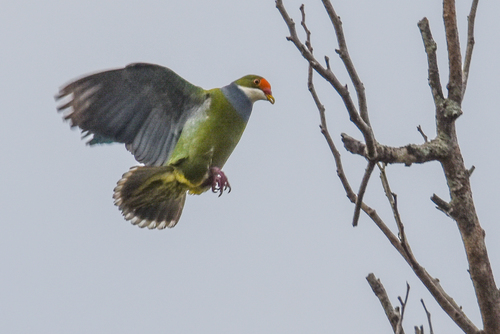
Orange-fronted Fruit-Dove
Ptilinopus aurantiifrons

Beautiful Fruit-Dove
Ptilinopus pulchellus

Pink-spotted Fruit-Dove
Ptilinopus perlatus
Global Distribution
Where this species is recorded worldwide. Restricted to human observations from 2019 onwards — the same kind of record and the same period the probabilities on this page are built from, so collar-tracking studies, camera-trap arrays and museum specimens are excluded. Around Santa Rosa that removes 5,924 GPS fixes from a handful of tagged jaguars.
where this species is recorded (GBIF density — it tracks where observers go, not how likely a sighting is) · parks where it occurs — tap a pin for the sighting probability there
Parks Where Found
| # | Park | Country | Daily sighting probability |
|---|---|---|---|
| 1 | Raja Ampat | 🇮🇩 Indonesia | |
| 2 | Tangkoko Nature Reserve | 🇮🇩 Indonesia |
Quick answers
What are the chances of seeing a Stephan's Emerald Dove in Raja Ampat?
About 10% of wildlife watchers report a Stephan's Emerald Dove sighting in Raja Ampat, based on 204 verified sightings from GBIF citizen-science data.
When is the best time to see Stephan's Emerald Dove in Raja Ampat?
June has the highest sighting rate for Stephan's Emerald Dove in Raja Ampat in our monthly data.