
Sultan's Cuckoo-Dove
Macropygia doreya
- KingdomAnimalia (Animals)
- PhylumChordata (Chordates)
- ClassAves (Birds)
- OrderColumbiformes (Pigeons and Doves)
- FamilyColumbidae (Pigeons and Doves)
- GenusMacropygia (Typical Cuckoo-Doves)
- SpeciesMacropygia doreya (Sultan's Cuckoo-Dove)
About the Sultan's Cuckoo-Dove
Sultan's cuckoo-dove (Macropygia doreya) is a dove in the genus Macropygia found in the northern Moluccas, Sulawesi to New Guinea and the western Papuan islands. It was one of three new species defined when the slender-billed cuckoo-dove was split up in 2016.
They are typically about 35–37 centimetres (14–15 in) long. The males tend to have a slight rose/green colouration on their nape and neck. Many subspecies have whitish underparts, fine dark barring below and/or a whitish cap.
The call of this dove is a very loud "whoop-a whoop" with some differences depending on the subspecies involved. Sultan's cuckoo-dove inhabits rainforest, woodland, scrubland and rainforest regrowth areas. The doves can often be seen in pairs or groups. Its diet consists of berries from both native plants and introduced weed species. They can be nomadic, depending on the supplies of food. They tend to fly short distances and low to the ground with great strength.
Breeding occurs in spring and summer. The nest is a flat platform of sticks and vines, either in a fork of a tree or on top of a low tree. One, creamy white, egg is laid. M. d. doreya Bonaparte, 1854 - western New... Wikipedia →
Closest Relatives at Raja Ampat

Black-billed Cuckoo-Dove
Macropygia nigrirostris

Pinon Imperial-Pigeon
Ducula pinon

Claret-breasted Fruit-Dove
Ptilinopus viridis

Spice Imperial-Pigeon
Ducula myristicivora

Pied Imperial Pigeon
Ducula bicolor

Western Crowned-Pigeon
Goura cristata

Great Cuckoo-Dove
Reinwardtoena reinwardti

Wompoo Fruit Dove
Ptilinopus magnificus

Stephan's Emerald Dove
Chalcophaps stephani
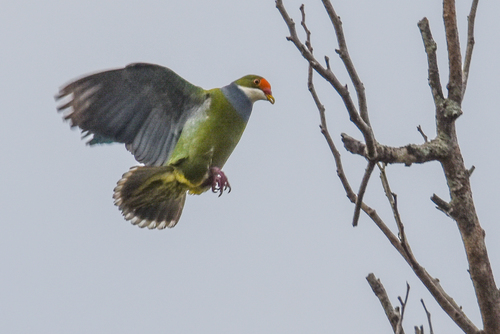
Orange-fronted Fruit-Dove
Ptilinopus aurantiifrons

Beautiful Fruit-Dove
Ptilinopus pulchellus

Pink-spotted Fruit-Dove
Ptilinopus perlatus
Global Distribution
Where this species is recorded worldwide. Restricted to human observations from 2019 onwards — the same kind of record and the same period the probabilities on this page are built from, so collar-tracking studies, camera-trap arrays and museum specimens are excluded. Around Santa Rosa that removes 5,924 GPS fixes from a handful of tagged jaguars.
where this species is recorded (GBIF density — it tracks where observers go, not how likely a sighting is) · parks where it occurs — tap a pin for the sighting probability there
Parks Where Found
| # | Park | Country | Daily sighting probability |
|---|---|---|---|
| 1 | Raja Ampat | 🇮🇩 Indonesia | |
| 2 | Tangkoko Nature Reserve | 🇮🇩 Indonesia |
Quick answers
What are the chances of seeing a Sultan's Cuckoo-Dove in Raja Ampat?
About 30% of wildlife watchers report a Sultan's Cuckoo-Dove sighting in Raja Ampat, based on 395 verified sightings from GBIF citizen-science data.
When is the best time to see Sultan's Cuckoo-Dove in Raja Ampat?
October has the highest sighting rate for Sultan's Cuckoo-Dove in Raja Ampat in our monthly data.