
Superb Fruit-Dove
Ptilinopus superbus
- KingdomAnimalia (Animals)
- PhylumChordata (Chordates)
- ClassAves (Birds)
- OrderColumbiformes (Pigeons and Doves)
- FamilyColumbidae (Pigeons and Doves)
- GenusPtilinopus (Typical Fruit Doves)
- SpeciesPtilinopus superbus (Superb Fruit-Dove)
About the Superb Fruit-Dove
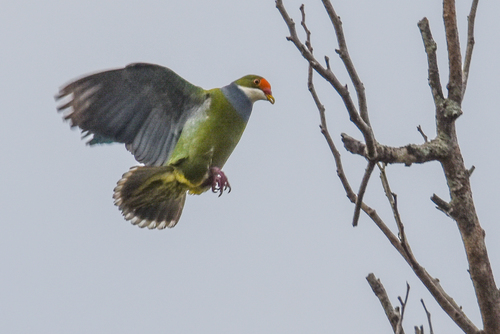
The superb fruit dove (Ptilinopus superbus), also known as the purple-crowned fruit dove (leading to easy confusion with the purple-capped fruit dove), is a medium-sized (22–24 cm long), colourful fruit-dove in the family Columbidae.
It is sexually dimorphic. Males are superbly coloured with a fiery orange nape, green ears, and a purple crown. The breast is grey, and divided from the abdomen by a wide, dark blue band. Their wings are olive green covered with dark spots, and the tail is tipped with white. Females are mostly green, with a white abdomen, blue wing tips, light blue breast, and a small, dark blue spot on the back of the head. Both sexes have yellow eyes and eye-rings. Despite its colourful plumage, the superb fruit dove is well-camouflaged amongst the rainforest foliage.
Native to Australasia, the superb fruit dove lives in the rainforests of New Guinea, Australia, Solomon Islands, the Philippines and Sulawesi of Indonesia. In Australia, it is found from southern New South Wales around the town of Moruya and extends further north, where it becomes more common to Cape York in Queensland. In some areas of its range, such as the New Guinean rainforest... Wikipedia →
Closest Relatives at Raja Ampat

Claret-breasted Fruit-Dove
Ptilinopus viridis

Wompoo Fruit Dove
Ptilinopus magnificus
Orange-fronted Fruit-Dove
Ptilinopus aurantiifrons

Beautiful Fruit-Dove
Ptilinopus pulchellus

Pink-spotted Fruit-Dove
Ptilinopus perlatus

Orange-bellied Fruit-Dove
Ptilinopus iozonus

White-breasted Fruit-Dove
Ptilinopus rivoli

Dwarf Fruit-Dove
Ptilinopus nainus
Coroneted Fruit-Dove
Ptilinopus coronulatus

Pinon Imperial-Pigeon
Ducula pinon

Spice Imperial-Pigeon
Ducula myristicivora

Sultan's Cuckoo-Dove
Macropygia doreya
Global Distribution
Where this species is recorded worldwide. Restricted to human observations from 2019 onwards — the same kind of record and the same period the probabilities on this page are built from, so collar-tracking studies, camera-trap arrays and museum specimens are excluded. Around Santa Rosa that removes 5,924 GPS fixes from a handful of tagged jaguars.
where this species is recorded (GBIF density — it tracks where observers go, not how likely a sighting is) · parks where it occurs — tap a pin for the sighting probability there
Parks Where Found
| # | Park | Country | Daily sighting probability |
|---|---|---|---|
| 1 | Daintree National Park | 🇦🇺 Australia | |
| 2 | Raja Ampat | 🇮🇩 Indonesia | |
| 3 | Noosa National Park | 🇦🇺 Australia | |
| 4 | Tangkoko Nature Reserve | 🇮🇩 Indonesia |
Quick answers
What are the chances of seeing a Superb Fruit-Dove in Raja Ampat?
Under 5% of wildlife watchers report a Superb Fruit-Dove sighting in Raja Ampat, based on 46 verified sightings from GBIF citizen-science data.
When is the best time to see Superb Fruit-Dove in Raja Ampat?
December has the highest sighting rate for Superb Fruit-Dove in Raja Ampat in our monthly data.