
Swinhoe's Snipe
Gallinago megala
- KingdomAnimalia (Animals)
- PhylumChordata (Chordates)
- ClassAves (Birds)
- OrderCharadriiformes (Shorebirds and Allies)
- FamilyScolopacidae (Sandpipers and Allies)
- GenusGallinago (Typical Snipes)
- SpeciesGallinago megala (Swinhoe's Snipe)
About the Swinhoe's Snipe
Swinhoe's snipe (Gallinago megala), also known as forest snipe or Chinese snipe, is a medium-sized (length 27–29 cm, wingspan 38–44 cm, weight 120 gm), long-billed, migratory wader. The common name commemorates the British naturalist Robert Swinhoe who first described the species in 1861.
It is identifiable as a Gallinago snipe by its cryptically patterned black, brown, buff and white plumage, but it is not easily distinguished from Latham's and pin-tailed snipe in the field. The species is commonly referred to as a cho suekyung in South Korea.
It breeds mainly in central and southern Siberia and Mongolia. The entire population migrates and spends the non-breeding season principally in eastern and southern India, Sri Lanka, south-eastern China, South-East Asia and New Guinea. It has been recorded on migration in eastern China and occasionally in Japan. Records in Australia are mainly from the Top End of the Northern Territory and from north-western Western Australia.
Breeding habitat: forest glades and meadows. Non-breeding habitat: shallow freshwater wetlands of various kinds including paddy fields and sewage farms, with bare mud... Wikipedia →
Closest Relatives at Raja Ampat
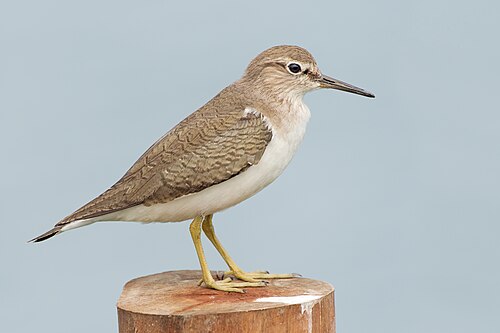
Common Sandpiper
Actitis hypoleucos

Whimbrel
Numenius phaeopus

Red-necked Phalarope
Phalaropus lobatus

Grey-tailed Tattler
Tringa brevipes

Great Knot
Calidris tenuirostris

Curlew Sandpiper
Calidris ferruginea

Little Stint
Calidris minuta

Common Greenshank
Tringa nebularia

Bar-tailed Godwit
Limosa lapponica

Wood Sandpiper
Tringa glareola

Sharp-tailed Sandpiper
Calidris acuminata

Ruddy Turnstone
Arenaria interpres
Global Distribution
Where this species is recorded worldwide. Restricted to human observations from 2019 onwards — the same kind of record and the same period the probabilities on this page are built from, so collar-tracking studies, camera-trap arrays and museum specimens are excluded. Around Santa Rosa that removes 5,924 GPS fixes from a handful of tagged jaguars.
where this species is recorded (GBIF density — it tracks where observers go, not how likely a sighting is) · parks where it occurs — tap a pin for the sighting probability there
Parks Where Found
| # | Park | Country | Daily sighting probability |
|---|---|---|---|
| 1 | Gobi Gurvansaikhan National Park | 🇲🇳 Mongolia | |
| 2 | Raja Ampat | 🇮🇩 Indonesia |
Quick answers
What are the chances of seeing a Swinhoe's Snipe in Raja Ampat?
Under 5% of wildlife watchers report a Swinhoe's Snipe sighting in Raja Ampat, based on 11 verified sightings from GBIF citizen-science data.
When is the best time to see Swinhoe's Snipe in Raja Ampat?
September has the highest sighting rate for Swinhoe's Snipe in Raja Ampat in our monthly data.