


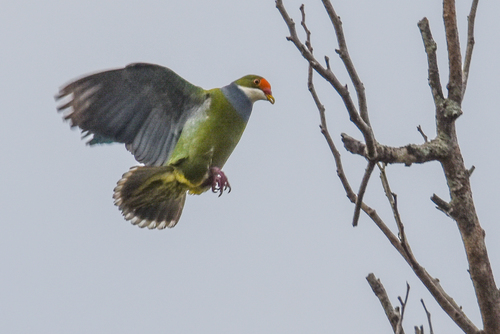
Wompoo Fruit Dove
Ptilinopus magnificus
- KingdomAnimalia (Animals)
- PhylumChordata (Chordates)
- ClassAves (Birds)
- OrderColumbiformes (Pigeons and Doves)
- FamilyColumbidae (Pigeons and Doves)
- GenusPtilinopus (Typical Fruit Doves)
- SpeciesPtilinopus magnificus (Wompoo Fruit Dove)
About the Wompoo Fruit Dove
The wompoo fruit dove (Megaloprepia magnifica), also known as wompoo pigeon and "magnificent fruit dove" among others, is one of the larger fruit doves native to New Guinea and eastern Australia. The wompoo fruit dove was formally described in 1821 by the Dutch zoologist Coenraad Jacob Temminck from a specimen that had been collected on the east coast of Australia. He placed it with the doves and pigeons in the genus Columba and coined the binomial name Columba magnifica. This fruit dove was formerly placed in the genus Ptilinopus. A molecular genetic study published in 2014 found that the fruit dove genus Ptilinopus was paraphyletic. In order to create monophyletic genera, nine species were moved from Ptilinopus to Ramphiculus and two species, the scarlet-breasted fruit dove and the wompoo fruit dove, were moved from Ptilinopus to Megaloprepia. The name Megaloprepia is from Ancient Greek μεγαλοπρεπεια/megaloprepeia meaning "magnificence".
Five subspecies are recognised: M. m. puella (Lesson, RP & Garnot, 1827) – Raja Ampat Islands (northwest of New Guinea, except Gebe and Kofiau) and Bird's Head Peninsula (northwest New Guinea) M. m. poliura Salvadori, 1878 – Yapen... Wikipedia →
Closest Relatives at Raja Ampat

Claret-breasted Fruit-Dove
Ptilinopus viridis
Orange-fronted Fruit-Dove
Ptilinopus aurantiifrons

Beautiful Fruit-Dove
Ptilinopus pulchellus

Pink-spotted Fruit-Dove
Ptilinopus perlatus

Orange-bellied Fruit-Dove
Ptilinopus iozonus

White-breasted Fruit-Dove
Ptilinopus rivoli

Dwarf Fruit-Dove
Ptilinopus nainus

Superb Fruit-Dove
Ptilinopus superbus
Coroneted Fruit-Dove
Ptilinopus coronulatus

Pinon Imperial-Pigeon
Ducula pinon

Spice Imperial-Pigeon
Ducula myristicivora

Sultan's Cuckoo-Dove
Macropygia doreya
Global Distribution
Where this species is recorded worldwide. Restricted to human observations from 2019 onwards — the same kind of record and the same period the probabilities on this page are built from, so collar-tracking studies, camera-trap arrays and museum specimens are excluded. Around Santa Rosa that removes 5,924 GPS fixes from a handful of tagged jaguars.
where this species is recorded (GBIF density — it tracks where observers go, not how likely a sighting is) · parks where it occurs — tap a pin for the sighting probability there
Parks Where Found
| # | Park | Country | Daily sighting probability |
|---|---|---|---|
| 1 | Daintree National Park | 🇦🇺 Australia | |
| 2 | Raja Ampat | 🇮🇩 Indonesia | |
| 3 | Springbrook National Park | 🇦🇺 Australia | |
| 4 | Lamington National Park | 🇦🇺 Australia | |
| 5 | Noosa National Park | 🇦🇺 Australia |
Quick answers
What are the chances of seeing a Wompoo Fruit Dove in Raja Ampat?
About 10% of wildlife watchers report a Wompoo Fruit Dove sighting in Raja Ampat, based on 214 verified sightings from GBIF citizen-science data.
When is the best time to see Wompoo Fruit Dove in Raja Ampat?
February has the highest sighting rate for Wompoo Fruit Dove in Raja Ampat in our monthly data.