


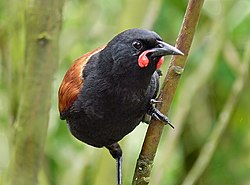


South Island Saddleback
Philesturnus carunculatus
Silhouette: Sheatherius · PhyloPic
- KingdomAnimalia (Animals)
- PhylumChordata (Chordates)
- ClassAves (Birds)
- OrderPasseriformes (Perching Birds)
- FamilyCallaeatidae
- GenusPhilesturnus (Saddlebacks)
- SpeciesPhilesturnus carunculatus (South Island Saddleback)
About the South Island Saddleback
The South Island saddleback or tīeke (Philesturnus carunculatus) is a forest-dwelling passerine bird in the New Zealand wattlebird family which is endemic to the South Island of New Zealand. Both the North Island saddleback and this species were formerly considered conspecific. The Department of Conservation currently has the South Island saddleback listed as At Risk--Declining.
The South Island saddleback was first formally described in 1789 by the German naturalist Johann Friedrich Gmelin in his revised and expanded edition of Carl Linnaeus's Systema Naturae. He placed it with the starlings in the genus Sturnus and coined the binomial name Sturnus carunculatus. The specific epithet carunculatus is Latin for a small piece of flesh, hence wattles. Gmelin based his description on the "wattled stare" that had been described and illustrated in 1783 by the English ornithologist John Latham in his book A General Synopsis of Birds. Latham has examined a specimen in the collection of the Leverian Museum in London that had come from New Zealand. The word "stare" is an archaic word for a starling. The South Island saddleback is now placed with the North Island saddleback in the... Wikipedia →
Recent sightings of South Island Saddleback in Rakiura National Park
LIVEiNaturalistClosest Relatives at Rakiura National Park

 Tūī
Tūī
Prosthemadera novaeseelandiae

New Zealand Bellbird
Anthornis melanura

 New Zealand Fantail
Rhipidura fuliginosa

 Grey Warbler
Gerygone igata

South Island Robin
Petroica australis

 Mōhua (Yellowhead)
Mohoua ochrocephala

 Eurasian Blackbird
Turdus merula

 Chaffinch
Fringilla coelebs

Miromiro
Petroica macrocephala

 European Starling
Sturnus vulgaris

 Dunnock
Prunella modularis

 Welcome Swallow
Hirundo neoxena
Global Distribution
Warmer areas are where this animal is recorded most often.
Parks Where Found
| # | Park | Country | Daily sighting probability |
|---|---|---|---|
| 1 | Rakiura National Park | 🇳🇿 New Zealand | |
| 2 | Fiordland National Park | 🇳🇿 New Zealand | |
| 3 | Abel Tasman National Park | 🇳🇿 New Zealand |
Quick answers
What are the chances of seeing a South Island Saddleback in Rakiura National Park?
About 40% of wildlife watchers report a South Island Saddleback sighting in Rakiura National Park, based on 835 verified sightings from GBIF citizen-science data.
When is the best time to see South Island Saddleback in Rakiura National Park?
May has the highest sighting rate for South Island Saddleback in Rakiura National Park in our monthly data.