



Mascarene Martin
Phedina borbonica
Silhouette: Sheatherius · PhyloPic
- KingdomAnimalia (Animals)
- PhylumChordata (Chordates)
- ClassAves (Birds)
- OrderPasseriformes (Perching Birds)
- FamilyHirundinidae (Swallows and Martins)
- GenusPhedina
- SpeciesPhedina borbonica (Mascarene Martin)
About the Mascarene Martin
The Mascarene martin or Mascarene swallow (Phedina borbonica) is a passerine bird in the swallow family that breeds in Madagascar and in the Mascarene Islands. The nominate subspecies occurs on Mauritius and Réunion and has never been found away from the Mascarene Islands, but the smaller Madagascan subspecies, P. b. madagascariensis, is migratory and has been recorded wintering in East Africa or wandering to other Indian Ocean islands.
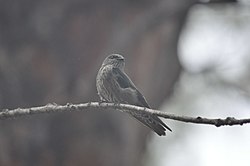
The Mascarene martin is a small swallow that has grey-brown underparts becoming white on the throat and lower abdomen, dark grey-brown upperparts and a slightly forked tail. The underparts are heavily streaked with black. It nests in small colonies anywhere with suitably sheltered sites for constructing a nest, such as ledges, buildings, tunnels, caves or amongst rocks. The nest is a shallow cup of twigs and other plant material, and the normal clutch is two or three brown-spotted white eggs. The incubation and fledging times are unknown. The Mascarene martin has a heavy flight with slow wingbeats interspersed with glides, and frequently perches on wires. It feeds on insects in flight, often hunting low over the ground or vegetation. In eastern Africa, open habitats such as deforested areas are frequently used for hunting. A number of internal and external parasites have been detected in this species.
Tropical cyclones can adversely affect populations on the smaller islands, but the Mascarene martin is a locally common bird with an apparently stable population and is classed as a species of Least Concern by the International Union for Conservation of Nature (IUCN). Its legal protection ranges from none on the French overseas department of Réunion to a status on Mauritius as a "species of wildlife in respect of which more severe penalties are provided". Wikipedia →
Recent sightings of Mascarene Martin in Ranomafana National Park
LIVEiNaturalistClosest Relatives at Ranomafana National Park

 Plain Martin
Riparia paludicola

 Barn Swallow
Hirundo rustica

 Madagascar Bulbul
Hypsipetes madagascariensis

 Souimanga Sunbird
Cinnyris sovimanga

 Madagascar White-eye
Zosterops maderaspatanus

Tylas Vanga
Tylas eduardi

 Madagascar Paradise-Flycatcher
Terpsiphone mutata

 Madagascar Magpie-Robin
Copsychus albospecularis

Malagasy Brush Warbler
Nesillas typica

Red-tailed Vanga
Calicalicus madagascariensis

 Crested Drongo
Dicrurus forficatus

Common Newtonia
Newtonia brunneicauda
Global Distribution
Warmer areas are where this animal is recorded most often.
Parks Where Found
| # | Park | Country | Daily sighting probability |
|---|---|---|---|
| 1 | Ranomafana National Park | 🇲🇬 Madagascar | |
| 2 | Ankarafantsika National Park | 🇲🇬 Madagascar | |
| 3 | Berenty Reserve | 🇲🇬 Madagascar | |
| 4 | Tsavo East National Park | 🇰🇪 Kenya |
Quick answers
What are the chances of seeing a Mascarene Martin in Ranomafana National Park?
About 40% of wildlife watchers report a Mascarene Martin sighting in Ranomafana National Park, based on 349 verified sightings from GBIF citizen-science data.
When is the best time to see Mascarene Martin in Ranomafana National Park?
September has the highest sighting rate for Mascarene Martin in Ranomafana National Park in our monthly data.