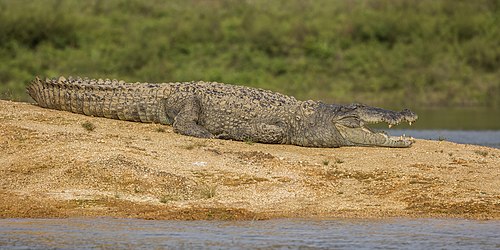



Mugger Crocodile
Crocodylus palustris
Silhouette: Steven Traver · PhyloPic
- KingdomAnimalia (Animals)
- PhylumChordata (Chordates)
- ClassCrocodylia
- FamilyCrocodylidae (Crocodiles)
- GenusCrocodylus (Typical Crocodiles)
- SpeciesCrocodylus palustris (Mugger Crocodile)
About the Mugger Crocodile
The mugger crocodile (Crocodylus palustris) is a medium-sized broad-snouted crocodile, also known as mugger and marsh crocodile. It is native to freshwater habitats from south-eastern Iran to the Indian subcontinent, where it inhabits marshes, lakes, rivers and artificial ponds. It rarely reaches a body length of 5 m (16 ft 5 in) and is a powerful swimmer, but also walks on land in search of suitable waterbodies during the hot season. Both young and adult mugger crocodiles dig burrows to which they retreat when the ambient temperature drops below 5 °C (41 °F) or exceeds 38 °C (100 °F). Females dig holes in the sand as nesting sites and lay up to 46 eggs during the dry season. The sex of hatchlings depends on temperature during incubation. Both parents protect the young for up to one year. They feed on insects, and adults prey on fish, reptiles, birds and mammals.
The mugger crocodile evolved at least 4.19 million years ago and has been a symbol for the fructifying and destructive powers of the rivers since the Vedic period. It was first scientifically described in 1831 and is protected by law in Iran, India and Sri Lanka. Since 1982, it has been listed as Vulnerable on the IUCN Red List. Outside protected areas, it is threatened by conversion of natural habitats, gets entangled in fishing nets and is killed in human–wildlife conflict situations and in traffic accidents. Wikipedia →
Recent sightings of Mugger Crocodile in Ranthambore National Park
LIVEiNaturalistGlobal Distribution
Warmer areas are where this animal is recorded most often.
Parks Where Found
| # | Park | Country | Daily sighting probability |
|---|---|---|---|
| 1 | Yala National Park | 🇱🇰 Sri Lanka | |
| 2 | Chitwan National Park | 🇳🇵 Nepal | |
| 3 | Wilpattu National Park | 🇱🇰 Sri Lanka | |
| 4 | Ranthambore National Park | 🇮🇳 India | |
| 5 | Royal Bardia National Park | 🇳🇵 Nepal | |
| 6 | Gir National Park | 🇮🇳 India | |
| 7 | Satpura National Park | 🇮🇳 India | |
| 8 | Minneriya National Park | 🇱🇰 Sri Lanka | |
| 9 | Jim Corbett National Park | 🇮🇳 India | |
| 10 | Bandipur National Park | 🇮🇳 India | |
| 11 | Nagarhole National Park | 🇮🇳 India |
Quick answers
What are the chances of seeing a Mugger Crocodile in Ranthambore National Park?
About 70% of wildlife watchers report a Mugger Crocodile sighting in Ranthambore National Park, based on 124 verified sightings from GBIF citizen-science data.
When is the best time to see Mugger Crocodile in Ranthambore National Park?
December has the highest sighting rate for Mugger Crocodile in Ranthambore National Park in our monthly data.