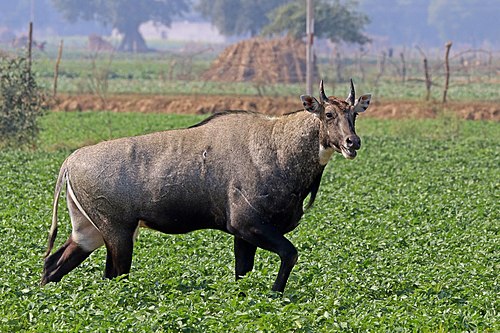



Nilgai
Boselaphus tragocamelus
Silhouette: [unknown] · PhyloPic
- KingdomAnimalia (Animals)
- PhylumChordata (Chordates)
- ClassMammalia (Mammals)
- OrderArtiodactyla (Even-toed Ungulates and Cetaceans)
- FamilyBovidae (Bovids)
- GenusBoselaphus (Nilgais)
- SpeciesBoselaphus tragocamelus (Nilgai)
About the Nilgai
The nilgai (Boselaphus tragocamelus) (literally meaning "blue cow") is the largest antelope in Asia. It is ubiquitous across the northern Indian subcontinent. It is the sole living member of the genus Boselaphus, which was first scientifically described by Peter Simon Pallas in 1766. It is a sturdy, thin-legged antelope with a sloping back, a deep neck with a white patch on the throat, a short crest of hair along the neck terminating in a tuft, and white facial spots. A column of pendant, coarse hair hangs from the dewlap ridge below the white patch. It stands 100–150 cm (39–59 in) at the shoulder; males weigh 109–288 kg (240–635 lb), and the lighter females 100–213 kg (220–470 lb). Sexual dimorphism is prominent; while females and juveniles are orange to tawny, adult males have a bluish-grey coat. Only males have horns, which are 15–24 cm (5.9–9.4 in) long.
Major nilgai populations occur in the Indian and Nepal Terai. The diurnal nilgai prefers areas with short bushes and scattered trees in scrub forests and grassy plains. It commonly occurs on agricultural land and rarely in dense forests. Its diet encompasses grasses and herbs, though it also eats woody plants in the dry tropical forests of India. Females become sexually mature by two years, while males do not become sexually active until four or five years old. The time of the year when mating takes place varies geographically, but a peak breeding season lasting three to four months can be observed at most places. Gestation lasts eight to nine months, following which a single calf is born, sometimes also twins or even triplets. Nilgai calves stay hidden for the first few weeks of their lives. Three distinct kinds of groups have been observed: one or two females with young calves, three to six adult and yearling females with calves, and all-male groups with two to 18 members. The lifespan of the nilgai is around 10 years. Typically tame, the nilgai may appear timid and cautious if harassed or alarmed; it flees up to 300 m (980 ft), or even 700 m (2,300 ft), galloping away from the source of danger.
The nilgai is categorised as least concern on the IUCN Red List. Feral nilgai are an invasive species in Texas, USA, where it was introduced in 1924. Wikipedia →
Recent sightings of Nilgai in Ranthambore National Park
LIVEiNaturalistClosest Relatives at Ranthambore National Park


Global Distribution
Warmer areas are where this animal is recorded most often.
Parks Where Found
| # | Park | Country | Daily sighting probability |
|---|---|---|---|
| 1 | Keoladeo National Park | 🇮🇳 India | |
| 2 | Ranthambore National Park | 🇮🇳 India | |
| 3 | Gir National Park | 🇮🇳 India | |
| 4 | Bandhavgarh National Park | 🇮🇳 India | |
| 5 | Satpura National Park | 🇮🇳 India | |
| 6 | Kanha National Park | 🇮🇳 India |
Quick answers
What are the chances of seeing a Nilgai in Ranthambore National Park?
About 70% of wildlife watchers report a Nilgai sighting in Ranthambore National Park, based on 118 verified sightings from GBIF citizen-science data.
When is the best time to see Nilgai in Ranthambore National Park?
July has the highest sighting rate for Nilgai in Ranthambore National Park in our monthly data.