



Green Vine Snake
Oxybelis fulgidus
Silhouette: Alex Slavenko · PhyloPic
- KingdomAnimalia (Animals)
- PhylumChordata (Chordates)
- ClassSquamata
- FamilyColubridae (Colubrid Snakes)
- GenusOxybelis (Vine Snakes)
- SpeciesOxybelis fulgidus (Green Vine Snake)
About the Green Vine Snake
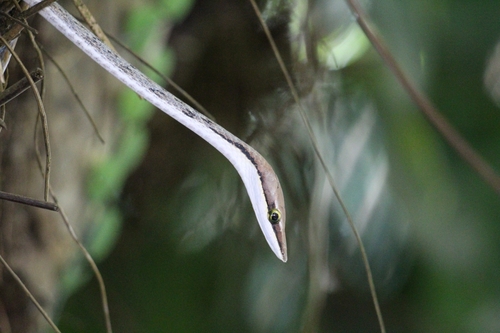
Oxybelis fulgidus, commonly known as the green vine snake, is a species of slender, arboreal, opisthoglyphous ('rear-fanged') colubrid serpent which is endemic to Central America and northern South America. Common names used in South America for this species include bejuca lora, bejuquilla verde, cobra-cipó, and cobra-bicuda.
Oxybelis fulgidus is found in mainland Latin America, primarily in Belize, Bolivia, Brazil, Colombia, Costa Rica, Ecuador, El Salvador, French Guiana, Guatemala, Guyana, Honduras, Mexico, Nicaragua, Panama, Peru, Suriname and Venezuela.
This snake is very slender, roughly 2 cm (0.79 in) thick, and may attain a total length of about 1.5–2 m (59–79 in). The tail is long and very delicate, but mostly used to hold on while reaching for prey. The head is aerodynamically shaped and very pointy, the mouth is very large and extends almost the whole length of the head. The tongue is long and green; when in use it is kept outside the mouth and moved up and down. This behavior is reflected in other species of vine snake and it is believed that they are using their tongues as sights the way a cat uses its whiskers... Wikipedia →
Recent sightings of Green Vine Snake in Rincón de la Vieja National Park
LIVEiNaturalistClosest Relatives at Rincón de la Vieja National Park
 Köhler’s Vine Snake
Oxybelis koehleri

Black-banded Snake
Scolecophis atrocinctus

Puffing Snake
Phrynonax poecilonotus

Green Rat Snake
Senticolis triaspis

Dryad Snake
Mastigodryas melanolomus

Lower-montane Green Racer
Drymobius melanotropis

Double-banded Coral Snake Mimic
Erythrolamprus bizona

 Central American Tree Snake
Imantodes gemmistratus

Central American Lyresnake
Trimorphodon quadruplex

Central American Indigo Snake
Drymarchon melanurus

Cope's Black-striped Snake
Coniophanes piceivittis

Common Mussurana
Clelia clelia
Global Distribution
Warmer areas are where this animal is recorded most often.
Parks Where Found
| # | Park | Country | Daily sighting probability |
|---|---|---|---|
| 1 | Tortuguero National Park | 🇨🇷 Costa Rica | |
| 2 | Calakmul Biosphere Reserve | 🇲🇽 Mexico | |
| 3 | Sian Ka'an Biosphere Reserve | 🇲🇽 Mexico | |
| 4 | Tambopata National Reserve | 🇵🇪 Peru | |
| 5 | Monteverde Cloud Forest Reserve | 🇨🇷 Costa Rica | |
| 6 | Soberanía National Park | 🇵🇦 Panama | |
| 7 | Brownsberg Nature Park | 🇸🇷 Suriname | |
| 8 | Anavilhanas National Park | 🇧🇷 Brazil | |
| 9 | Sierra de la Macarena National Park | 🇨🇴 Colombia | |
| 10 | Biotopo Cerro Cahuí | 🇬🇹 Guatemala | |
| 11 | Rincón de la Vieja National Park | 🇨🇷 Costa Rica | |
| 12 | Tikal National Park | 🇬🇹 Guatemala | |
| 13 | Ostional Wildlife Refuge | 🇨🇷 Costa Rica | |
| 14 | Amacayacu National Natural Park | 🇨🇴 Colombia | |
| 15 | Santa Rosa National Park | 🇨🇷 Costa Rica | |
| 16 | Cerro Azul Meámbar National Park | 🇭🇳 Honduras | |
| 17 | Ría Lagartos Biosphere Reserve | 🇲🇽 Mexico | |
| 18 | Cañón del Sumidero National Park | 🇲🇽 Mexico | |
| 19 | Manuel Antonio National Park | 🇨🇷 Costa Rica | |
| 20 | Cuyabeno Wildlife Reserve | 🇪🇨 Ecuador | |
| 21 | La Amistad International Park (Panama) | 🇵🇦 Panama |