

Bank Myna
Acridotheres ginginianus
Silhouette: Andy Wilson · PhyloPic
- KingdomAnimalia (Animals)
- PhylumChordata (Chordates)
- ClassAves (Birds)
- OrderPasseriformes (Perching Birds)
- FamilySturnidae (Starlings)
- GenusAcridotheres (Typical Mynas)
- SpeciesAcridotheres ginginianus (Bank Myna)
About the Bank Myna
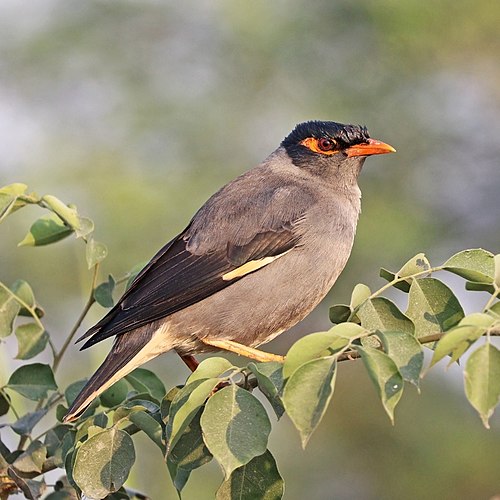
The bank myna (Acridotheres ginginianus) is a myna found in the northern parts of South Asia. It is smaller but similar in colouration to the common myna, only differing in having brick-red naked skin behind the eyes instead of yellow. It is greyer on the underside and in this and in the presence of a slight tuft of feathers bears some resemblance to the jungle myna. They are found in flocks on the plains of northern and central India, often within towns and cities. Their range appears to be extending southwards into India. The name is derived from their habit of nesting almost exclusively in the earthen banks of rivers, where they excavate burrows and breed in large colonies.
The head is black on the crown and sides and the upper plumage is slaty grey while the underside is lighter grey with pale pink plumage towards the centre of the abdomen. The wing is black but has a wing patch at the base of the primaries and the tips of the outer tail feathers are pale pinkish buff. The naked skin behind the eye is brick red, the legs are yellow while the iris is deep red. The sexes are indistinguishable in the field. Young birds have a browner head and neck.
The species is... Wikipedia →
Recent sightings of Bank Myna in Royal Bardia National Park
LIVEiNaturalistClosest Relatives at Royal Bardia National Park

 Jungle Myna
Acridotheres fuscus

 Indian Pied Starling
Gracupica contra

Chestnut-tailed Starling
Sturnia malabarica

Brahminy Starling
Sturnia pagodarum

Spot-winged Starling
Saroglossa spiloptera

 Black-hooded Oriole
Oriolus xanthornus

 Rufous Treepie
Dendrocitta vagabunda

 Black Drongo
Dicrurus macrocercus

 Red-whiskered Bulbul
Pycnonotus jocosus

White-bellied Drongo
Dicrurus caerulescens

 Pied Bushchat
Saxicola caprata

 Cinereous Tit
Parus cinereus
Global Distribution
Warmer areas are where this animal is recorded most often.
Parks Where Found
| # | Park | Country | Daily sighting probability |
|---|---|---|---|
| 1 | Keoladeo National Park | 🇮🇳 India | |
| 2 | Ranthambore National Park | 🇮🇳 India | |
| 3 | Kaziranga National Park | 🇮🇳 India | |
| 4 | Bandhavgarh National Park | 🇮🇳 India | |
| 5 | Royal Bardia National Park | 🇳🇵 Nepal | |
| 6 | Chitwan National Park | 🇳🇵 Nepal | |
| 7 | Jim Corbett National Park | 🇮🇳 India | |
| 8 | Sundarbans National Park | 🇮🇳 India | |
| 9 | Kanha National Park | 🇮🇳 India | |
| 10 | Gir National Park | 🇮🇳 India | |
| 11 | Satpura National Park | 🇮🇳 India | |
| 12 | Manas National Park | 🇮🇳 India |
Quick answers
What are the chances of seeing a Bank Myna in Royal Bardia National Park?
Under 5% of wildlife watchers report a Bank Myna sighting in Royal Bardia National Park, based on 9 verified sightings from GBIF citizen-science data.
When is the best time to see Bank Myna in Royal Bardia National Park?
July has the highest sighting rate for Bank Myna in Royal Bardia National Park in our monthly data.