


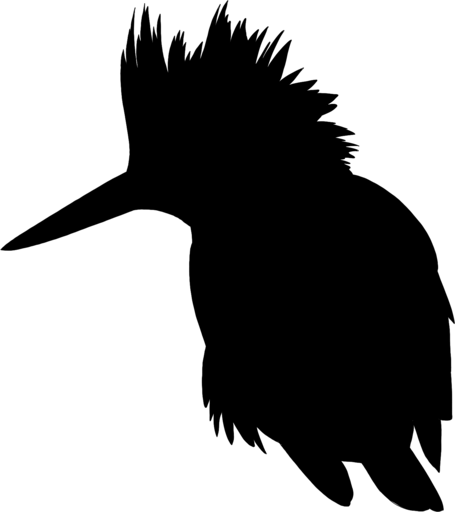
Crested Kingfisher
Megaceryle lugubris
Silhouette: Andy Wilson · PhyloPic
- KingdomAnimalia (Animals)
- PhylumChordata (Chordates)
- ClassAves (Birds)
- OrderCoraciiformes (Rollers, Kingfishers, and Allies)
- FamilyAlcedinidae (Kingfishers)
- GenusMegaceryle (Large Crested Kingfishers)
- SpeciesMegaceryle lugubris (Crested Kingfisher)
About the Crested Kingfisher
The crested kingfisher (Megaceryle lugubris) is a very large kingfisher that is native to parts of southern Asia. It is part of the kingfisher genus Megaceryle with three other species: the giant kingfisher (Megaceryle maxima), the ringed kingfisher (Megaceryle torquata), and the belted kingfisher (Megaceryle alcyon) with which it forms a species complex.
The crested kingfisher is a very large, stocky black and white bird, usually between 38 and 43 cm (15 and 17 in) tall, and weighs between 230 and 280 g (8 and 10 oz). It has a large, pointed black bill with a yellowish-white tip and a large, shaggy black and white barred crest. It has finely barred black and white upperparts with flanks barred grey and white, while its belly is white with a black-speckled breastband. It has a white collar that starts at the bottom of the bill and goes to the back of the neck. The tail feathers are black with 6 to 8 white bars. Males and females are the same size but exhibit sexual dimorphism in their plumage. Females have bright pink-cinnamon underwing coverts washed with pale rufous, while males lack this and instead have rufus-orange feathers on the breastband.
The... Wikipedia →
Recent sightings of Crested Kingfisher in Royal Bardia National Park
LIVEiNaturalistClosest Relatives at Royal Bardia National Park

 White-throated Kingfisher
Halcyon smyrnensis

 Common Kingfisher
Alcedo atthis

Stork-billed Kingfisher
Pelargopsis capensis

Pied Kingfisher
Ceryle rudis

 Asian Green Bee-eater
Merops orientalis

Chestnut-headed Bee-eater
Merops leschenaulti

 Indian Roller
Coracias benghalensis

Blue-tailed Bee-eater
Merops philippinus

Blue-bearded Bee-eater
Nyctyornis athertoni

Dollarbird
Eurystomus orientalis
Global Distribution
Warmer areas are where this animal is recorded most often.
Parks Where Found
| # | Park | Country | Daily sighting probability |
|---|---|---|---|
| 1 | Jim Corbett National Park | 🇮🇳 India | |
| 2 | Namdapha National Park | 🇮🇳 India | |
| 3 | Royal Manas National Park | 🇧🇹 Bhutan | |
| 4 | Manas National Park | 🇮🇳 India | |
| 5 | Chitwan National Park | 🇳🇵 Nepal | |
| 6 | Royal Bardia National Park | 🇳🇵 Nepal | |
| 7 | Nikko National Park | 🇯🇵 Japan |