


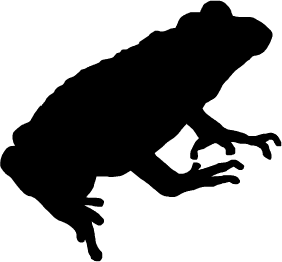
Jervis Bay Treefrog
Litoria jervisiensis
Silhouette: Robbi Bishop-Taylor · PhyloPic
- KingdomAnimalia (Animals)
- PhylumChordata (Chordates)
- ClassAmphibia (Amphibians)
- OrderAnura (Frogs and Toads)
- FamilyPelodryadidae (Australasian Tree Frogs)
- GenusLitoria
- SpeciesLitoria jervisiensis (Jervis Bay Treefrog)
About the Jervis Bay Treefrog
The Jervis Bay tree frog (Rawlinsonia jervisiensis), also known as the curry frog in reference to its odour, is a species of Australian frog associated with wallum swampland along the east coast of New South Wales; ranging from the Queensland border to eastern Victoria.
This is a moderately large species of tree frog, up to 55 mm in length. It is normally brown in dorsal colour and has a large double band on the back starting from between the eyes and down to the vent; this band may be indistinct in some specimens. It has a dark band starting at the snout and ending at the base of the arms. The armpits are coloured yellow and the thighs red-orange. The iris is golden-brown in colour. Toe discs are large and the toes are webbed.
Until 1994, this species was not recognised as distinct from the heath frog, Rawlinsonia littlejohni. The heath frog is larger in size and has orange instead of yellow in the armpits. This species of frog is strongly associated with coastal swamps, particularly wallum swampland. Males call in the cooler months, normally after rain. The call is a three-noted "weep-weep-weep". Breeding tends to take place... Wikipedia →
Recent sightings of Jervis Bay Treefrog in Royal National Park
LIVEiNaturalistClosest Relatives at Royal National Park

 Peron's Tree Frog
Litoria peronii

Eastern Dwarf Treefrog
Litoria fallax

Wallum Rocket Frog
Litoria freycineti

Verreaux's Tree Frog
Litoria verreauxii

 Leaf Green Treefrog
Ranoidea phyllochroa

 Common Eastern Froglet
Crinia signifera

Red-crowned Toadlet
Pseudophryne australis

 Giant Burrowing Frog
Heleioporus australiacus

Striped Marsh Frog
Limnodynastes peronii

Pobblebonk
Limnodynastes dumerilii

Haswell's Froglet
Paracrinia haswelli
Global Distribution
Warmer areas are where this animal is recorded most often.
Parks Where Found
| # | Park | Country | Daily sighting probability |
|---|---|---|---|
| 1 | Booderee National Park | 🇦🇺 Australia | |
| 2 | Royal National Park | 🇦🇺 Australia |