

Central American Indigo Snake
Drymarchon melanurus
Silhouette: Alex Slavenko · PhyloPic
- KingdomAnimalia (Animals)
- PhylumChordata (Chordates)
- ClassSquamata
- FamilyColubridae (Colubrid Snakes)
- GenusDrymarchon (Indigo Snakes)
- SpeciesDrymarchon melanurus (Central American Indigo Snake)
About the Central American Indigo Snake
The Middle American indigo snake (Drymarchon melanurus), also known commonly as the blacktail cribo, is a species of large, nonvenomous, snake in the family Colubridae. The species is native to the southwestern United States, Mexico, Central America, and northern South America. In addition to the nominate subspecies, it has four other recognized subspecies, including D. m. erebennus, commonly known as the Texas indigo snake.
D. melanurus is a large species that can grow to a total length (including tail) of 1.80 m (6 ft) to over 2.40 m (8 ft). This species has predominantly olive-brown glossy dorsal scales evolving to black at the tail. The underside is a lighter olive-yellow, olive-tan color.
D. melanurus has distinctive dark markings round the eyes, a vertical dark slash just behind the jaw. and a heavy diagonal dark slash on both sides of the neck. The subspecies D. m. erebennus is predominantly solid black, though there can be lighter shaded variations.
The geographic range of D. melanurus extends from southern Texas southwards through the Gulf Coast of Mexico, the Yucatán Peninsula, Guatemala and Belize. On the Pacific coast... Wikipedia →
Recent sightings of Central American Indigo Snake in Santa Rosa National Park
LIVEiNaturalistClosest Relatives at Santa Rosa National Park

 Rhombic Cat-eyed Snake
Leptodeira rhombifera

 Central American Lyresnake
Trimorphodon quadruplex
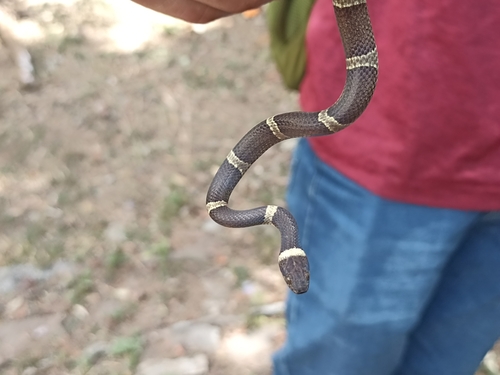
Black-banded Cat-eyed Snake
Leptodeira nigrofasciata

Cope's Black-striped Snake
Coniophanes piceivittis

Cope's Snail Sucker
Sibon anthracops
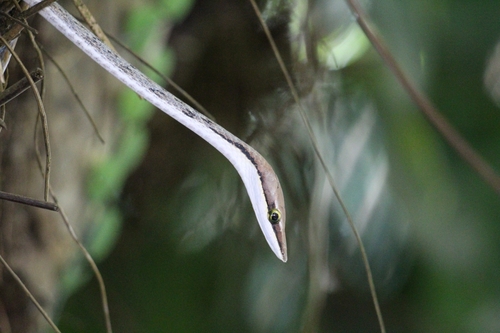
Köhler’s Vine Snake
Oxybelis koehleri

Speckled Racer
Drymobius margaritiferus

 Blunthead Tree Snake
Imantodes cenchoa

Central American Tree Snake
Imantodes gemmistratus
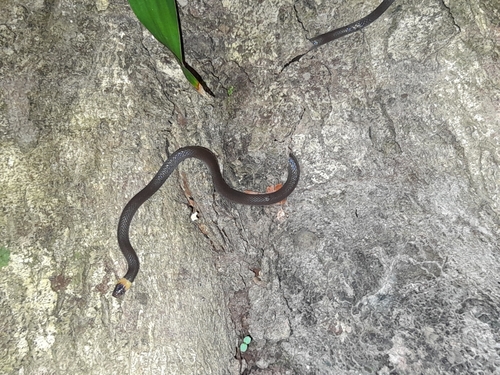
Pacific Longtail Snake
Enulius flavitorques

Green Rat Snake
Senticolis triaspis

Blood Snake
Stenorrhina freminvillei
Global Distribution
Warmer areas are where this animal is recorded most often.
Parks Where Found
| # | Park | Country | Daily sighting probability |
|---|---|---|---|
| 1 | Santa Rosa National Park | 🇨🇷 Costa Rica | |
| 2 | Calakmul Biosphere Reserve | 🇲🇽 Mexico | |
| 3 | Sian Ka'an Biosphere Reserve | 🇲🇽 Mexico | |
| 4 | Cockscomb Basin Wildlife Sanctuary | 🇧🇿 Belize | |
| 5 | Cusuco National Park | 🇭🇳 Honduras | |
| 6 | Celaque National Park | 🇭🇳 Honduras | |
| 7 | Puracé National Natural Park | 🇨🇴 Colombia | |
| 8 | Celestún Biosphere Reserve | 🇲🇽 Mexico | |
| 9 | Masaya Volcano National Park | 🇳🇮 Nicaragua | |
| 10 | Rincón de la Vieja National Park | 🇨🇷 Costa Rica | |
| 11 | Cañón del Sumidero National Park | 🇲🇽 Mexico | |
| 12 | Ría Lagartos Biosphere Reserve | 🇲🇽 Mexico | |
| 13 | Tikal National Park | 🇬🇹 Guatemala | |
| 14 | Cabo Blanco Absolute Nature Reserve | 🇨🇷 Costa Rica | |
| 15 | Monteverde Cloud Forest Reserve | 🇨🇷 Costa Rica |
Quick answers
What are the chances of seeing a Central American Indigo Snake in Santa Rosa National Park?
About 10% of wildlife watchers report a Central American Indigo Snake sighting in Santa Rosa National Park, based on 6 verified sightings from GBIF citizen-science data.
When is the best time to see Central American Indigo Snake in Santa Rosa National Park?
March has the highest sighting rate for Central American Indigo Snake in Santa Rosa National Park in our monthly data.