

Yellow-throated Big-eared Bat
Lampronycteris brachyotis
Silhouette: Roberto Díaz Sibaja · PhyloPic
- KingdomAnimalia (Animals)
- PhylumChordata (Chordates)
- ClassMammalia (Mammals)
- OrderChiroptera (Bats)
- FamilyPhyllostomidae (New World Leaf-nosed Bats)
- GenusLampronycteris
- SpeciesLampronycteris brachyotis (Yellow-throated Big-eared Bat)
About the Yellow-throated Big-eared Bat
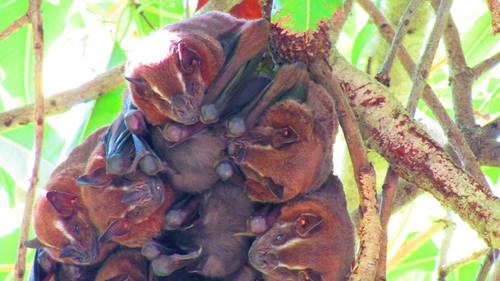
The yellow-throated big-eared bat or orange-throated bat(Lampronycteris brachyotis) is a species of bat that ranges from southern Mexico to Brazil. It is the only species within the genus Lampronycteris. A frugivore and insectivore, it is found in lowland forest up to an elevation of 700 m. Its activity is greatest in the first two hours after sunset, and peaks again after midnight.
The yellow-throated big-eared bat is characterized as a "medium-sized" leaf-nosed bat. Its ears are short and pointed, and its nose-leaf is relatively small. Its dorsal fur is dark brown or orange brown, and the ventral fur is orange or reddish-yellow. Individual bats weigh 9–15 g (0.32–0.53 oz) and have forearm lengths of 39–43 mm (1.5–1.7 in). The bat's dental formula is 2.1.2.32.1.3.3 for a total of 34 teeth.
The yellow-throated big-eared bat is primarily an insectivore, but it will also consume fruit, nectar, and pollen. It is nocturnal, roosting in sheltered places during the day, such as caves, mines, hollow trees, and archaeological ruins. It generally roosts in small colonies consisting of 10 or fewer individuals, though a colony of 300 individuals was... Wikipedia →
Recent sightings of Yellow-throated Big-eared Bat in Santa Rosa National Park
LIVEiNaturalistClosest Relatives at Santa Rosa National Park

 Pallas's Long-tongued Bat
Glossophaga soricina
 Great Fruit-eating Bat
Artibeus lituratus

 Seba's Short-tailed Bat
Carollia perspicillata

Vampire Bat
Desmodus rotundus

Jamaican Fruit-eating Bat
Artibeus jamaicensis

Thomas's Fruit-eating Bat
Artibeus watsoni

White-winged Vampire Bat
Diaemus youngii

gray short-tailed bat
Carollia subrufa

Hairy Big-eyed Bat
Chiroderma villosum

 Greater Bulldog Bat
Noctilio leporinus

Greater Sac-winged Bat
Saccopteryx bilineata

Espirito Santo Free-tailed Bat
Nyctinomops laticaudatus
Global Distribution
Warmer areas are where this animal is recorded most often.
Parks Where Found
| # | Park | Country | Daily sighting probability |
|---|---|---|---|
| 1 | Calakmul Biosphere Reserve | 🇲🇽 Mexico | |
| 2 | Santa Rosa National Park | 🇨🇷 Costa Rica | |
| 3 | Soberanía National Park | 🇵🇦 Panama |