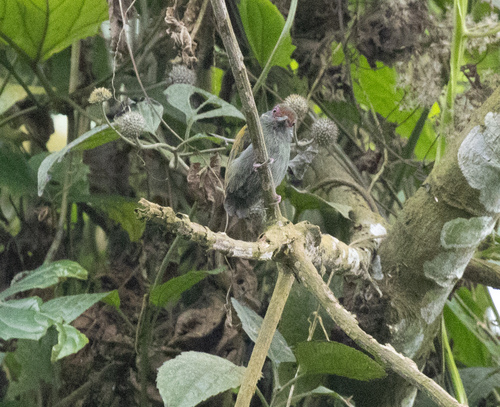

African Piculet
Sasia africana
Silhouette: Pepe Reigada · PhyloPic
- KingdomAnimalia (Animals)
- PhylumChordata (Chordates)
- ClassAves (Birds)
- OrderPiciformes (Woodpeckers and Allies)
- FamilyPicidae (Woodpeckers)
- GenusSasia (Asian Piculets)
- SpeciesSasia africana (African Piculet)
About the African Piculet
The African piculet (Verreauxia africana), sometimes placed in the genus Sasia, is a species of bird in the family Picidae. It is the only species placed in the genus Verreauxia. It is found in Angola, Cameroon, Central African Republic, Republic of the Congo, Democratic Republic of the Congo, Ivory Coast, Equatorial Guinea, Gabon, Ghana, Liberia, and Uganda. This species is described as locally common and has a very large range, so the International Union for Conservation of Nature has rated its conservation status as being of "least concern".
The African piculet was formally described in 1855 by the French naturalists Jules and Édouard Verreaux from a specimen collected in Gabon, West Africa. They placed it in the genus Sasia and coined the binomial name Sasia africana. The African piculet is now the only species placed in the genus Verreauxia that was introduced in 1856 by the German ornithologist Gustav Hartlaub. The species is monotypic: no subspecies are recognised.
The African piculet is a small bird some 9 to 10 cm (3.5 to 3.9 in) long. The male has a chestnut or reddish forehead and a greyish-green or olive-green crown whereas the forehead in... Wikipedia →
Recent sightings of African Piculet in Semuliki National Park
LIVEiNaturalistClosest Relatives at Semuliki National Park

 Golden-crowned Woodpecker
Chloropicus xantholophus

Gabon Woodpecker
Dendropicos gabonensis

 Yellow-Billed Barbet
Trachyphonus purpuratus

 Yellow-throated Tinkerbird
Pogoniulus subsulphureus

Speckled Tinkerbird
Pogoniulus scolopaceus

Red-rumped Tinkerbird
Pogoniulus atroflavus

Hairy-breasted Barbet
Tricholaema hirsuta

Yellow-rumped Tinkerbird
Pogoniulus bilineatus

Yellow-spotted Barbet
Buccanodon duchaillui

 Least Honeyguide
Indicator exilis

Cassin's Honeyguide
Prodotiscus insignis

Grey-throated Barbet
Gymnobucco bonapartei
Global Distribution
Warmer areas are where this animal is recorded most often.
Parks Where Found
| # | Park | Country | Daily sighting probability |
|---|---|---|---|
| 1 | Semuliki National Park | 🇺🇬 Uganda | |
| 2 | Bwindi Impenetrable National Park | 🇺🇬 Uganda | |
| 3 | Virunga National Park | 🇨🇩 Democratic Republic of the Congo |
Quick answers
What are the chances of seeing a African Piculet in Semuliki National Park?
About 20% of wildlife watchers report a African Piculet sighting in Semuliki National Park, based on 65 verified sightings from GBIF citizen-science data.
When is the best time to see African Piculet in Semuliki National Park?
February has the highest sighting rate for African Piculet in Semuliki National Park in our monthly data.