


Red-breasted Hill Partridge
Arborophila hyperythra
- KingdomAnimalia (Animals)
- PhylumChordata (Chordates)
- ClassAves (Birds)
- OrderGalliformes (Landfowl)
- FamilyPhasianidae (Pheasants, Grouse, and Allies)
- GenusArborophila (Hill-Partridges)
- SpeciesArborophila hyperythra (Red-breasted Hill Partridge)
About the Red-breasted Hill Partridge
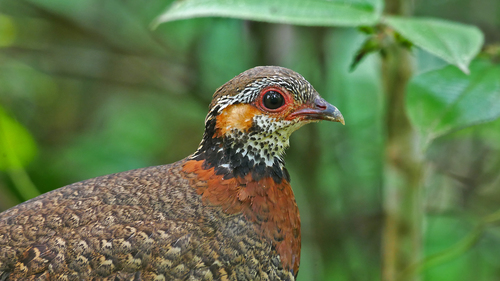
The red-breasted partridge (Arborophila hyperythra), also known as the Bornean hill-partridge, is a species of bird in the family Phasianidae. It is endemic to hill and montane forest in Borneo, preferring bamboos and thickets. The International Union for Conservation of Nature (IUCN) has assessed it as a least-concern species.
Richard Bowdler Sharpe described this species as Bambusicola hyperythra in 1879, from specimens collected in northwestern Borneo by William Hood Treacher, who was Acting Governor of Labuan at that time. In 1890, Sharpe described the population on Mount Kinabalu as Bambusicola erythrophrys. It was formerly considered a subspecies, but it has been suggested that the brighter plumage on the face is due to age differences. The species is currently considered monotypic.
The red-breasted partridge is about 27 cm (11 in) long and weighs about 270 g (9.5 oz). The crown and nape are blackish, with brown spots. There is a grey or rufous supercilium, and a blackish-brown band goes through the eye. The cheeks and throat are rufous. The breast is bright chestnut, sometimes browner, and the belly is whitish. The flanks are black and white... Wikipedia →


Global Distribution
Where this species is recorded worldwide. Restricted to human observations from 2019 onwards — the same kind of record and the same period the probabilities on this page are built from, so collar-tracking studies, camera-trap arrays and museum specimens are excluded. Around Santa Rosa that removes 5,924 GPS fixes from a handful of tagged jaguars.
where this species is recorded (GBIF density — it tracks where observers go, not how likely a sighting is) · parks where it occurs — tap a pin for the sighting probability there
Parks Where Found
| # | Park | Country | Daily sighting probability |
|---|---|---|---|
| 1 | Kinabalu Park | 🇲🇾 Malaysia | |
| 2 | Sepilok | 🇲🇾 Malaysia |