

Split Keelback
Atretium schistosum
Silhouette: Alex Slavenko · PhyloPic
- KingdomAnimalia (Animals)
- PhylumChordata (Chordates)
- ClassSquamata
- FamilyColubridae (Colubrid Snakes)
- GenusAtretium (Olive Keelbacks)
- SpeciesAtretium schistosum (Split Keelback)
About the Split Keelback
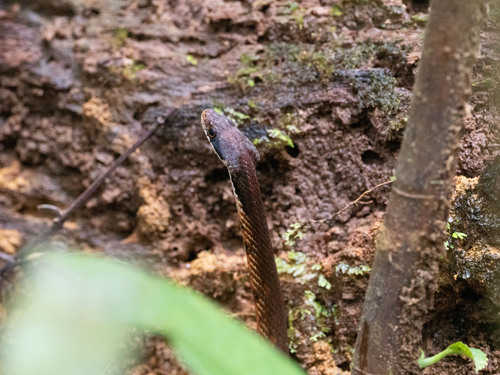
Atretium schistosum, also known commonly as the split keelback and the olive keelback wart snake, is a species of snake in the subfamily Natricinae of the family Colubridae. The species, which is the sole species in the genus Atretium, is native to South Asia.
It is a common and harmless watersnake. A. schistosum is found in Sri Lanka, India, Bangladesh and Nepal. In India it occurs in peninsular India south of latitude 15 degrees north and along the east coast to Uttarakhand. It is reported to be very common around Bangalore, North Arcot district (Tamil Nadu) and Kakinada area in Andhra Pradesh. Occurs up to 1000 m (3280 ft) above sea level. Absent from most of North India.
A. schistosum is a small, robust snake with thin head, short snout and slit nostrils placed rather high. The snake is olive-green and yellow to orange below. It is sometimes tinged with pink or purplish on the flanks. The length of the tail is one third to one-fourth of the total length.
The dorsal scales are rough because they are keeled. Specimens from South India have a distinct reddish line along the 5th and 6th or the 4th and 5th up to the vent. This line is brighter... Wikipedia →
Recent sightings of Split Keelback in Sinharaja Forest Reserve
LIVEiNaturalistClosest Relatives at Sinharaja Forest Reserve

 Green Vine Snake
Ahaetulla nasuta

Boulenger's Keelback
Fowlea asperrimus

Stripe-Tailed Bronzeback
Dendrelaphis caudolineolatus

Ceylon Wolf Snake
Lycodon carinatus

Schokar's bronzeback
Dendrelaphis schokari

Beddome's Cat Snake
Boiga beddomei

Dhaman
Ptyas mucosa

Duméril's Kukri Snake
Oligodon sublineatus

Barnes' Cat Snake
Boiga barnesii

Sri Lanka Cat Snake
Boiga ceylonensis
 Blossom Krait
Rhabdophis ceylonensis

Templeton's Kukri Snake
Oligodon calamarius
Global Distribution
Warmer areas are where this animal is recorded most often.
Parks Where Found
| # | Park | Country | Daily sighting probability |
|---|---|---|---|
| 1 | Sinharaja Forest Reserve | 🇱🇰 Sri Lanka | |
| 2 | Minneriya National Park | 🇱🇰 Sri Lanka |
Quick answers
What are the chances of seeing a Split Keelback in Sinharaja Forest Reserve?
About 20% of wildlife watchers report a Split Keelback sighting in Sinharaja Forest Reserve, based on 5 verified sightings from GBIF citizen-science data.
When is the best time to see Split Keelback in Sinharaja Forest Reserve?
September has the highest sighting rate for Split Keelback in Sinharaja Forest Reserve in our monthly data.