


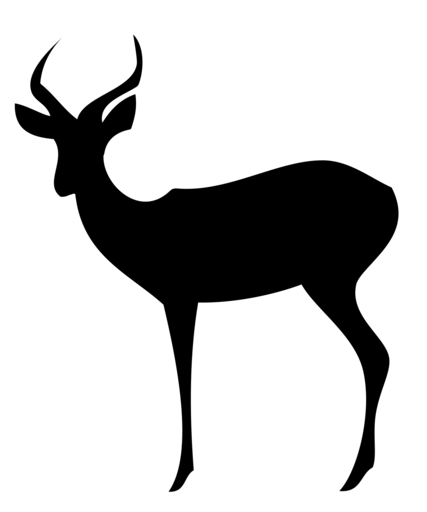
Springbok
Antidorcas marsupialis
Silhouette: Sarah Werning · PhyloPic
- KingdomAnimalia (Animals)
- PhylumChordata (Chordates)
- ClassMammalia (Mammals)
- OrderArtiodactyla (Even-toed Ungulates and Cetaceans)
- FamilyBovidae (Bovids)
- GenusAntidorcas (Springboks)
- SpeciesAntidorcas marsupialis (Springbok)
About the Springbok
The springbok or springbuck (Antidorcas marsupialis) is an antelope found mainly in south and southwest Africa. The sole living member of the genus Antidorcas, this bovid was first described by the German zoologist Eberhard August Wilhelm von Zimmermann in 1780. Three subspecies are identified. A slender, long-legged antelope, the springbok reaches 71 to 86 cm (28 to 34 in) at the shoulder and weighs between 27 and 42 kg (60 and 93 lb). Both sexes have a pair of black, 35 to 50 cm (14 to 20 in) long horns that curve backwards. The springbok is characterised by a white face, a dark stripe running from the eyes to the mouth, a light brown coat marked by a reddish-brown stripe that runs from the upper foreleg to the buttocks across the flanks like the Thomson's gazelle, and a white rump flap.
Active mainly at dawn and dusk, springbok form harems (mixed-sex herds). In earlier times, springbok of the Kalahari Desert and Karoo migrated in large numbers across the countryside, a practice known as trekbokking. A feature, peculiar but not unique, to the springbok is pronking, in which the springbok performs multiple leaps into the air, up to 2 m (6 ft 7 in) above the ground, in a stiff-legged posture, with the back bowed and the white flap lifted. Primarily a browser, the springbok feeds on shrubs and succulents; this antelope can live without drinking water for years, meeting its requirements through eating succulent vegetation. Breeding takes place year-round, and peaks in the rainy season, when forage is most abundant. A single calf is born after a five- to six-month-long pregnancy; weaning occurs at nearly six months of age, and the calf leaves its mother a few months later.
Springbok inhabit the dry areas of south and southwestern Africa. The International Union for Conservation of Nature and Natural Resources classifies the springbok as a least concern species. No major threats to the long-term survival of the species are known; the springbok is one of the few antelope species considered to have an expanding population. They are popular game animals and are valued for their meat and skin. The springbok is the national mammal of South Africa. Wikipedia →
Recent sightings of Springbok in Table Mountain National Park
LIVEiNaturalistClosest Relatives at Table Mountain National Park

 Bontebok/Blesbok
Damaliscus pygargus

 Common Eland
Taurotragus oryx

Klipspringer
Oreotragus oreotragus

Himalayan Tahr
Hemitragus jemlahicus

Cape Grysbok
Raphicerus melanotis

 Khama
Alcelaphus caama

 Common Rhebok
Pelea capreolus

 Bush Duiker
Sylvicapra grimmia

 Hartebeest
Alcelaphus buselaphus

 Greater Kudu
Tragelaphus strepsiceros

 Common Hippopotamus
Hippopotamus amphibius

 Sambar
Rusa unicolor
Global Distribution
Warmer areas are where this animal is recorded most often.
Parks Where Found
| # | Park | Country | Daily sighting probability |
|---|---|---|---|
| 1 | Etosha National Park | 🇳🇦 Namibia | |
| 2 | Kgalagadi Transfrontier Park | 🇿🇦 South Africa | |
| 3 | Waterberg Plateau Park | 🇳🇦 Namibia | |
| 4 | Namib-Naukluft National Park | 🇳🇦 Namibia | |
| 5 | Pilanesberg National Park | 🇿🇦 South Africa | |
| 6 | Addo Elephant National Park | 🇿🇦 South Africa | |
| 7 | Garden Route National Park | 🇿🇦 South Africa | |
| 8 | Golden Gate Highlands National Park | 🇿🇦 South Africa | |
| 9 | Chobe National Park | 🇧🇼 Botswana | |
| 10 | Table Mountain National Park | 🇿🇦 South Africa |