
Mountain Peacock-Pheasant
Polyplectron inopinatum
- KingdomAnimalia (Animals)
- PhylumChordata (Chordates)
- ClassAves (Birds)
- OrderGalliformes (Landfowl)
- FamilyPhasianidae (Pheasants, Grouse, and Allies)
- GenusPolyplectron (Peacock-Pheasants)
- SpeciesPolyplectron inopinatum (Mountain Peacock-Pheasant)
About the Mountain Peacock-Pheasant
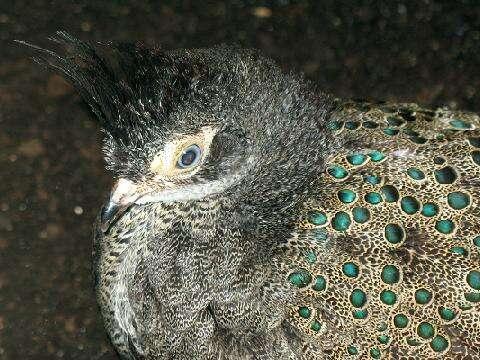
The mountain peacock-pheasant (Polyplectron inopinatum), also known as Rothschild's peacock-pheasant or mirror pheasant, is a medium-sized, up to 65 cm long, blackish brown pheasant. It is with small ocelli, long graduated tail feathers, and both sexes are similar. The male has metallic blue ocelli on upperparts, green ocelli on tail of twenty feathers and two spurs on legs. Female has black ocelli on upperparts, unspurred legs and tail of eighteen feathers. The female is smaller and duller than male.
A shy and elusive bird, the mountain peacock-pheasant is distributed and endemic to montane forests of the central Malay Peninsula. The diet consists mainly of berries, beetles and ants. Mitochondrial DNA cytochrome b and D-loop as well as the nuclear ovomucoid intron G data confirms that this species belongs to a clade together with the bronze-tailed peacock-pheasant, Germain's peacock-pheasant and grey peacock-pheasant (Kimball et al. 2001).
The molecular data suggests - though not with high confidence - that this species diverged from mainland stock earlier than the bronze-tailed peacock-pheasant. This is quite spurious, since its biogeography and derived plumage, and the fact that it is a peninsular mountain endemic indicate it is derived from a fairly small founder population; this would confound molecular analyses. What seems clear is that the present species evolved from mainland Southeast Asian stock, probably during the Late Pliocene to Early Pleistocene (3.6-1 myr). The unique pattern of wings and tail thus is, contrary to long-held opinion, an autapomorphy, and the southern species of this clade - formerly separated in the genus Chalcurus - are probably not each other's closest relatives.
While this species has a relatively small population size and limited range, the mountain peacock-pheasant is evaluated as Near Threatened on the IUCN Red List of Threatened Species due to its range being inaccessible, and thus, protected from human encroachment. It is listed on Appendix III of CITES in Malaysia. Wikipedia →
Closest Relatives at Taman Negara National Park
Malayan Peacock-Pheasant
Polyplectron malacense

Bornean Crested Fireback
Lophura ignita

Great Argus
Argusianus argus

Malayan Crested Argus
Rheinardia nigrescens

Red Junglefowl
Gallus gallus

Roulroul
Rollulus rouloul

Malay Crestless Fireback
Lophura erythrophthalma

Green Peafowl
Pavo muticus
Global Distribution
Where this species is recorded worldwide. Restricted to human observations from 2019 onwards — the same kind of record and the same period the probabilities on this page are built from, so collar-tracking studies, camera-trap arrays and museum specimens are excluded. Around Santa Rosa that removes 5,924 GPS fixes from a handful of tagged jaguars.
where this species is recorded (GBIF density — it tracks where observers go, not how likely a sighting is) · parks where it occurs — tap a pin for the sighting probability there
Parks Where Found
| # | Park | Country | Daily sighting probability |
|---|---|---|---|
| 1 | Taman Negara National Park | 🇲🇾 Malaysia |
More parks will be added in future updates.