

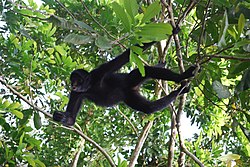


Black-faced Black Spider Monkey
Ateles chamek
Silhouette: Steven Traver · PhyloPic
- KingdomAnimalia (Animals)
- PhylumChordata (Chordates)
- ClassMammalia (Mammals)
- OrderPrimates
- FamilyAtelidae (Spider, Howler, and Woolly Monkeys)
- GenusAteles (Spider Monkeys)
- SpeciesAteles chamek (Black-faced Black Spider Monkey)
About the Black-faced Black Spider Monkey
The Peruvian spider monkey (Ateles chamek), also known as the black-faced black spider monkey, is a species of spider monkey that lives in Peru, as well as in Brazil and in Bolivia. At 60 centimetres (2 feet) long, they are relatively large among species of monkey, and their strong, prehensile tails can be up to 1 m (3 ft) long. Unlike many species of monkey, they have only a vestigial thumb, an adaptation which enables them to travel using brachiation. Peruvian spider monkeys live in groups of 20–30 individuals, but these groups are rarely all together simultaneously. The size and dynamics of the resulting subgroups vary with food availability and sociobehavioral activity. They prefer to eat fleshy fruit, but will change their diet in response to scarcity of ripe fruit. Individuals of this species also eat small animals, insects and leaves based on availability. Females separate from the band to give birth, typically in the fall. These females inhabit a group of core areas where resources are abundant in certain seasons. Typically, males exhibit ranging over longer distances than females, with movement of individuals enhancing the fluidity of subgroup size. Peruvian spider monkey are independent at about 10 months, with a lifespan of about 20 years. Wikipedia →
Recent sightings of Black-faced Black Spider Monkey in Tambopata National Reserve
LIVEiNaturalistClosest Relatives at Tambopata National Reserve

 Bolivian Red Howler Monkey
Alouatta sara

Colombian Red Howler Monkey
Alouatta seniculus

 Black-capped Squirrel Monkey
Saimiri boliviensis

 Brown Capuchin
Sapajus apella

 White-mantled Tamarin
Leontocebus weddelli

 Toppin's Titi
Plecturocebus toppini

 Black-headed Night Monkey
Aotus nigriceps

 Gray's Bald-faced Saki
Pithecia irrorata

 Shock-headed Capuchin
Cebus cuscinus

Azara’s Night Monkey
Aotus azarae

Urubamba Brown Titi
Plecturocebus urubambensis
Global Distribution
Warmer areas are where this animal is recorded most often.
Parks Where Found
| # | Park | Country | Daily sighting probability |
|---|---|---|---|
| 1 | Manu National Park | 🇵🇪 Peru | |
| 2 | Tambopata National Reserve | 🇵🇪 Peru | |
| 3 | Madidi National Park | 🇧🇴 Bolivia | |
| 4 | Noel Kempff Mercado National Park | 🇧🇴 Bolivia | |
| 5 | Amboró National Park | 🇧🇴 Bolivia | |
| 6 | Cordillera Azul National Park | 🇵🇪 Peru |
Quick answers
What are the chances of seeing a Black-faced Black Spider Monkey in Tambopata National Reserve?
About 20% of wildlife watchers report a Black-faced Black Spider Monkey sighting in Tambopata National Reserve, based on 38 verified sightings from GBIF citizen-science data.
When is the best time to see Black-faced Black Spider Monkey in Tambopata National Reserve?
May has the highest sighting rate for Black-faced Black Spider Monkey in Tambopata National Reserve in our monthly data.