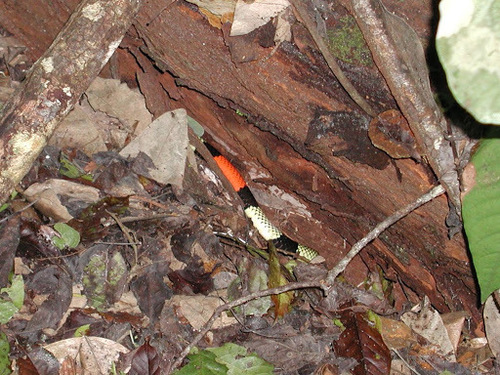

Black-necked Amazonian Coralsnake
Micrurus obscurus
Silhouette: Edwin Price · PhyloPic
- KingdomAnimalia (Animals)
- PhylumChordata (Chordates)
- ClassSquamata
- FamilyElapidae (Elapid Snakes)
- GenusMicrurus (Coralsnakes)
- SpeciesMicrurus obscurus (Black-necked Amazonian Coralsnake)
About the Black-necked Amazonian Coralsnake
Micrurus obscurus, also known commonly as the black-neck Amazonian coral snake and the Bolivian coral snake, is a species of venomous snake in the family Elapidae. The species is native to northwestern South America. The color pattern of Micrurus obscurus consists of black, red, and yellow (or white) rings. The black rings are arranged in triads of three black rings separated by two yellow rings. The triads are separated by red rings. The yellow rings are as wide or wider than the black rings. The dorsal scales within the yellow rings are heavily marked with black on the tips and edges, making the rings appear grayish or greenish. The red rings are the widest and also contain black marks. Most specimens have 4–6 triads on the body.
Males have 200–228 ventrals and 17–22 subcaudals. Females have 207–225 ventrals and 16–22 subcaudals. M. obscurus is a large species. The holotype of the synonym Elaps princeps has a total length (tail included) of 1.22 m (4.0 ft).
Micrurus obscurus is found in northern Bolivia, northwestern Brazil, southeastern Colombia, eastern Ecuador, and eastern Peru. The preferred natural habitat of Micrurus... Wikipedia →
Recent sightings of Black-necked Amazonian Coralsnake in Tambopata National Reserve
LIVEiNaturalistClosest Relatives at Tambopata National Reserve


Global Distribution
Warmer areas are where this animal is recorded most often.
Parks Where Found
| # | Park | Country | Daily sighting probability |
|---|---|---|---|
| 1 | Tambopata National Reserve | 🇵🇪 Peru | |
| 2 | Manu National Park | 🇵🇪 Peru | |
| 3 | Madidi National Park | 🇧🇴 Bolivia | |
| 4 | Amboró National Park | 🇧🇴 Bolivia |
Quick answers
What are the chances of seeing a Black-necked Amazonian Coralsnake in Tambopata National Reserve?
About 10% of wildlife watchers report a Black-necked Amazonian Coralsnake sighting in Tambopata National Reserve, based on 16 verified sightings from GBIF citizen-science data.
When is the best time to see Black-necked Amazonian Coralsnake in Tambopata National Reserve?
February has the highest sighting rate for Black-necked Amazonian Coralsnake in Tambopata National Reserve in our monthly data.