

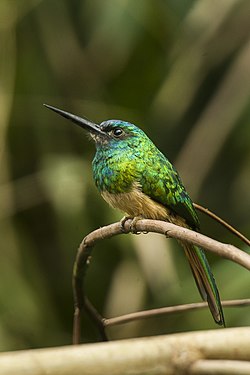

Bluish-fronted Jacamar
Galbula cyanescens
Silhouette: FJDegrange · PhyloPic
- KingdomAnimalia (Animals)
- PhylumChordata (Chordates)
- ClassAves (Birds)
- OrderPiciformes (Woodpeckers and Allies)
- FamilyGalbulidae (Jacamars)
- GenusGalbula (Typical Jacamars)
- SpeciesGalbula cyanescens (Bluish-fronted Jacamar)
About the Bluish-fronted Jacamar
The bluish-fronted jacamar (Galbula cyanescens) is a species of bird in the family Galbulidae. It is found in Bolivia, Brazil, and Peru. The bluish-fronted jacamar is monotypic. It and the rufous-tailed (Galbula ruficauda), white-chinned (G. tombacea), coppery-chested (G. pastazae), and green-tailed jacamars (G. galbula) are considered to form a superspecies.
The bluish-fronted jacamar is 20 to 23 cm (7.9 to 9.1 in) long and weighs 22 to 26 g (0.78 to 0.92 oz). The male's crown, including the forehead ("front") is metallic green to bluish and the upper parts are metallic green with a bluish gloss. The chin and upper throat are blackish, the lower throat and chest green, and the rest of the underparts rufous. The female differs only in that the lower breast and belly are ochraceous.
The bluish-fronted jacamar is found east of the Andes and south of the Amazon River, in eastern Peru, in western Brazil as far east as the Madeira River, and south into Bolivia's La Paz Department. It inhabits humid primary forest, gallery forest, and secondary forest up to 1,000 m (3,300 ft) elevation. It is typically found in... Wikipedia →
Recent sightings of Bluish-fronted Jacamar in Tambopata National Reserve
LIVEiNaturalistClosest Relatives at Tambopata National Reserve

 Paradise Jacamar
Galbula dea

White-throated Jacamar
Brachygalba albogularis

Purús Jacamar
Galbalcyrhynchus purusianus

Great Jacamar
Jacamerops aureus

 Black-fronted Nunbird
Monasa nigrifrons

 White-throated Toucan
Ramphastos tucanus

 Yellow-tufted Woodpecker
Melanerpes cruentatus

 Gilded Barbet
Capito auratus

 Channel-billed Toucan
Ramphastos vitellinus

 Chestnut-eared Aracari
Pteroglossus castanotis

Swallow-wing Puffbird
Chelidoptera tenebrosa

 Crimson-crested Woodpecker
Campephilus melanoleucos
Global Distribution
Warmer areas are where this animal is recorded most often.
Parks Where Found
| # | Park | Country | Daily sighting probability |
|---|---|---|---|
| 1 | Tambopata National Reserve | 🇵🇪 Peru | |
| 2 | Manu National Park | 🇵🇪 Peru | |
| 3 | Cordillera Azul National Park | 🇵🇪 Peru | |
| 4 | Madidi National Park | 🇧🇴 Bolivia |
Quick answers
What are the chances of seeing a Bluish-fronted Jacamar in Tambopata National Reserve?
About 30% of wildlife watchers report a Bluish-fronted Jacamar sighting in Tambopata National Reserve, based on 1,382 verified sightings from GBIF citizen-science data.
When is the best time to see Bluish-fronted Jacamar in Tambopata National Reserve?
May has the highest sighting rate for Bluish-fronted Jacamar in Tambopata National Reserve in our monthly data.