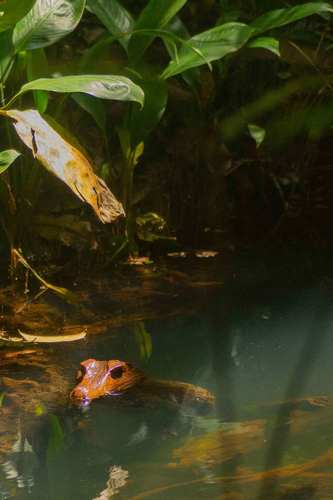

Cuvier's Smooth-fronted Caiman
Paleosuchus palpebrosus
Silhouette: PhyloPic · PhyloPic
- KingdomAnimalia (Animals)
- PhylumChordata (Chordates)
- ClassCrocodylia
- FamilyAlligatoridae (Alligators and Caimans)
- GenusPaleosuchus (Dwarf Caimans)
- SpeciesPaleosuchus palpebrosus (Cuvier's Smooth-fronted Caiman)
About the Cuvier's Smooth-fronted Caiman
Cuvier's dwarf caiman (Paleosuchus palpebrosus) is a small crocodilian in the alligator family from northern and central South America. It is found in Bolivia, Brazil, Colombia, Ecuador, French Guiana, Guyana, Paraguay, Peru, Suriname, Trinidad and Venezuela. It lives in riverine forests, flooded forests near lakes, and near fast-flowing rivers and streams. It can traverse dry land to reach temporary pools and tolerates colder water than other species of caimans. Other common names for this species include the musky caiman, the dwarf caiman, Cuvier's caiman, and the smooth-fronted caiman (the latter name is also used for P. trigonatus). It is sometimes kept in captivity as a pet and may be referred to as the wedge-head caiman by the pet trade community.
Cuvier's dwarf caiman was first described by the French zoologist Georges Cuvier in 1807 and is one of only two species in the genus Paleosuchus, the other species being P. trigonatus. Their closest relatives are the other caimans in the subfamily Caimaninae. With a total length averaging 1.4 m (4.6 ft) for males and up to 1.2 m (3.9 ft) for females, Cuvier's dwarf caiman is not only the smallest extant species in the alligator and caiman family, but also the smallest of all crocodilians (unless the Congo dwarf crocodile is considered a valid species). An adult weighs around 5 to 7 kg (11 to 15 lb). Its lack of size is partly made up for by its strong body armor, provided by the bony bases to its dermal scales, which provides protection against predators. Juvenile dwarf caimans mainly feed on invertebrates, but also small fish and frogs, while adults eat larger fish, amphibians, and invertebrates, such as large molluscs. This caiman sometimes uses a burrow as shelter during the day and in the Pantanal may aestivate in the burrow to stay cool in the dry season. The female buries her eggs on a mounded nest and these take about 3 months to hatch. She helps the hatchlings to escape from the nest and provides some parental care for the first few weeks of their lives. This caiman has a wide range and large total population, and the IUCN lists its conservation status as being of least concern. Wikipedia →
Recent sightings of Cuvier's Smooth-fronted Caiman in Tambopata National Reserve
LIVEiNaturalistClosest Relatives at Tambopata National Reserve


Global Distribution
Warmer areas are where this animal is recorded most often.
Parks Where Found
| # | Park | Country | Daily sighting probability |
|---|---|---|---|
| 1 | Emas National Park | 🇧🇷 Brazil | |
| 2 | Amacayacu National Natural Park | 🇨🇴 Colombia | |
| 3 | Anavilhanas National Park | 🇧🇷 Brazil | |
| 4 | Manu National Park | 🇵🇪 Peru | |
| 5 | Tambopata National Reserve | 🇵🇪 Peru |