

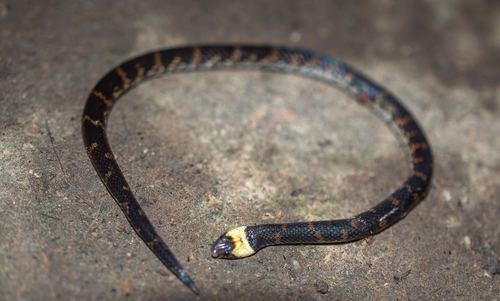
Erythrolamprus dorsocorallinus
Erythrolamprus dorsocorallinus
Silhouette: Alex Slavenko · PhyloPic
- KingdomAnimalia (Animals)
- PhylumChordata (Chordates)
- ClassSquamata
- FamilyColubridae (Colubrid Snakes)
- GenusErythrolamprus (Coral Snake Mimics)
- SpeciesErythrolamprus dorsocorallinus
About the Erythrolamprus dorsocorallinus
Erythrolamprus dorsocorallinus is a species of snake in the family Colubridae. The species is found in Venezuela, Brazil, Bolivia, and Peru. Wikipedia →
Recent sightings of Erythrolamprus dorsocorallinus in Tambopata National Reserve
LIVEiNaturalistClosest Relatives at Tambopata National Reserve

 Royal Ground Snake
Erythrolamprus reginae

Blind Ground Snake
Erythrolamprus typhlus

 Blunthead Tree Snake
Imantodes cenchoa

 Tschudi's False Coral Snake
Oxyrhopus melanogenys

Wucherer's Ground Snake
Xenopholis scalaris

Northern Woodland Racer
Drymoluber dichrous

Brown Sipo
Chironius fuscus

Common Mussurana
Clelia clelia

 Banded Cat-eyed Snake
Leptodeira annulata

Catesby's Snail-eater
Dipsas catesbyi
Pachacamac Ground Snake
Atractus snethlageae

Mountain Keelback
Helicops angulatus
Global Distribution
Warmer areas are where this animal is recorded most often.
Parks Where Found
| # | Park | Country | Daily sighting probability |
|---|---|---|---|
| 1 | Tambopata National Reserve | 🇵🇪 Peru | |
| 2 | Amboró National Park | 🇧🇴 Bolivia | |
| 3 | Cordillera Azul National Park | 🇵🇪 Peru |
Quick answers
What are the chances of seeing a Erythrolamprus dorsocorallinus in Tambopata National Reserve?
About 10% of wildlife watchers report a Erythrolamprus dorsocorallinus sighting in Tambopata National Reserve, based on 19 verified sightings from GBIF citizen-science data.
When is the best time to see Erythrolamprus dorsocorallinus in Tambopata National Reserve?
February has the highest sighting rate for Erythrolamprus dorsocorallinus in Tambopata National Reserve in our monthly data.