
Black-naped Tern
Sterna sumatrana
- KingdomAnimalia (Animals)
- PhylumChordata (Chordates)
- ClassAves (Birds)
- OrderCharadriiformes (Shorebirds and Allies)
- FamilyLaridae (Gulls, Terns, and Skimmers)
- GenusSterna (Typical Terns)
- SpeciesSterna sumatrana (Black-naped Tern)
About the Black-naped Tern
The black-naped tern (Sterna sumatrana) is an oceanic tern mostly found in tropical and subtropical areas of the Indian Ocean and western Pacific Ocean. They are rarely found inland. It was described from the islands around Sumatra. It is most closely related to roseate tern S. dougallii and white-fronted tern S. striata.
The black-naped tern is named from the black band beginning at the eyes connecting behind the head and descending the back of the neck. The rest of their plumage is white, with pale silvery-grey wings and mantle, apart from the outermost primary feather which has a narrow black outer web. The tail is white, and deeply forked, extending (like the related roseate and white-fronted terns) beyond the wingtips on perched birds. The beaks and legs are black. They have a body length of 30–35 cm and a wingspan of 66 cm. Adults weigh between 97 and 120 g. Hatchlings are mottled brown.
There are two listed subspecies: Sterna sumatrana sumatrana (Raffles, 1822) – islands of the eastern Indian Ocean through to the western Pacific, north to Taiwan and south to Queensland in Australia Sterna sumatrana mathewsi (Stresemann, 1914) – islands of the... Wikipedia →
Closest Relatives at Tangkoko Nature Reserve

Common Tern
Sterna hirundo

Whiskered Tern
Chlidonias hybrida

White-winged Tern
Chlidonias leucopterus

Little Tern
Sternula albifrons
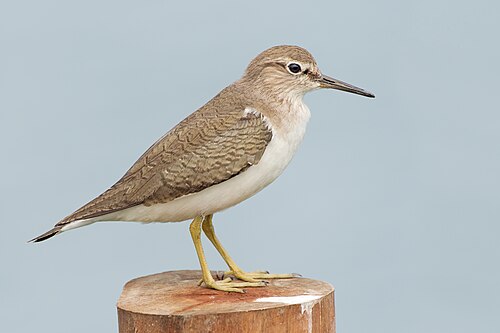
Common Sandpiper
Actitis hypoleucos

Kentish Plover
Charadrius alexandrinus

Whimbrel
Numenius phaeopus

Beach Thick-knee
Esacus magnirostris

Barred Buttonquail
Turnix suscitator

White-headed Stilt
Himantopus leucocephalus

Black-bellied Plover
Pluvialis squatarola

Grey-tailed Tattler
Tringa brevipes
Global Distribution
Where this species is recorded worldwide. Restricted to human observations from 2019 onwards — the same kind of record and the same period the probabilities on this page are built from, so collar-tracking studies, camera-trap arrays and museum specimens are excluded. Around Santa Rosa that removes 5,924 GPS fixes from a handful of tagged jaguars.
where this species is recorded (GBIF density — it tracks where observers go, not how likely a sighting is) · parks where it occurs — tap a pin for the sighting probability there
Parks Where Found
| # | Park | Country | Daily sighting probability |
|---|---|---|---|
| 1 | Raja Ampat | 🇮🇩 Indonesia | |
| 2 | Bali Barat National Park | 🇮🇩 Indonesia | |
| 3 | Tangkoko Nature Reserve | 🇮🇩 Indonesia | |
| 4 | Bako National Park | 🇲🇾 Malaysia | |
| 5 | Taroko National Park | 🇹🇼 Taiwan | |
| 6 | Daintree National Park | 🇦🇺 Australia | |
| 7 | Kinabatangan Wildlife Sanctuary | 🇲🇾 Malaysia |
Quick answers
What are the chances of seeing a Black-naped Tern in Tangkoko Nature Reserve?
Under 5% of wildlife watchers report a Black-naped Tern sighting in Tangkoko Nature Reserve, based on 7 verified sightings from GBIF citizen-science data.
When is the best time to see Black-naped Tern in Tangkoko Nature Reserve?
September has the highest sighting rate for Black-naped Tern in Tangkoko Nature Reserve in our monthly data.