


Gold-ringed Cat Snake
Boiga dendrophila
- KingdomAnimalia (Animals)
- PhylumChordata (Chordates)
- ClassSquamata
- FamilyColubridae (Colubrid Snakes)
- GenusBoiga (Australasian Cat Snakes)
- SpeciesBoiga dendrophila (Gold-ringed Cat Snake)
About the Gold-ringed Cat Snake
Boiga dendrophila, commonly called the mangrove snake or the gold-ringed cat snake, is a species of rear-fanged venomous snake in the family Colubridae. The species is endemic to southeast Asia. It is one of the biggest cat snake species, averaging 8–9 feet (2.4–2.7 m) in length. It is considered mildly venomous. Although moderate envenomations resulting in intense swelling have been reported, there has never been a confirmed fatality.
B. dendrophila has the following characteristics: Snout longer than eye; rostral broader than deep, visible from above; internasals as long as or shorter than the prae-frontals; frontal as long as or slightly shorter than its distance from the tip of the snout; loreal at least as long as deep; a praeocular extending to the upper surface of the head, not reaching the frontal; two postoculars; temporals 2 + 2 or 2 + 3; eight (nine) upper labials, third to fifth entering the eye; four or five lower labials in contact with the anterior chin-shields; latter as long as or longer than the posterior; anterior palatine teeth not much larger than the posterior.
Scales in 21 (23) rows, vertebral row enlarged; ventrals 209–239; anal entire; subcaudals... Wikipedia →
Closest Relatives at Tangkoko Nature Reserve

Brown Tree Snake
Boiga irregularis
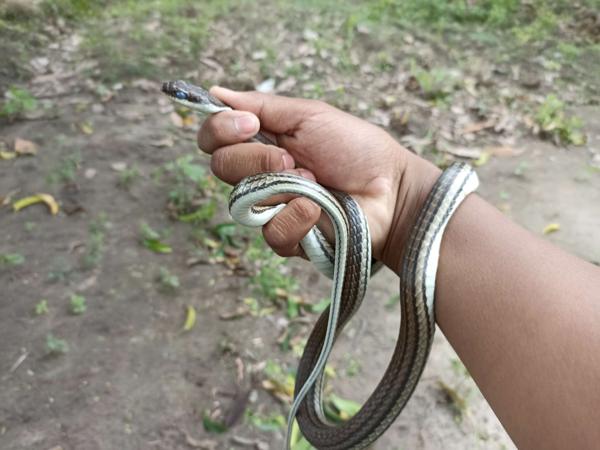
Terrific Bronzeback
Dendrelaphis terrificus
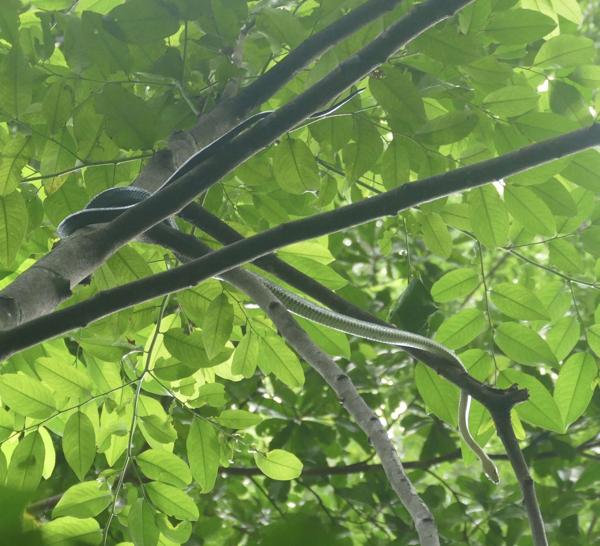
Celebes Black-Tailed Ratsnake
Gonyosoma jansenii

Oriental Whipsnake
Ahaetulla prasina

Maren's Bronzeback
Dendrelaphis marenae

Paradise Flying Snake
Chrysopelea paradisi
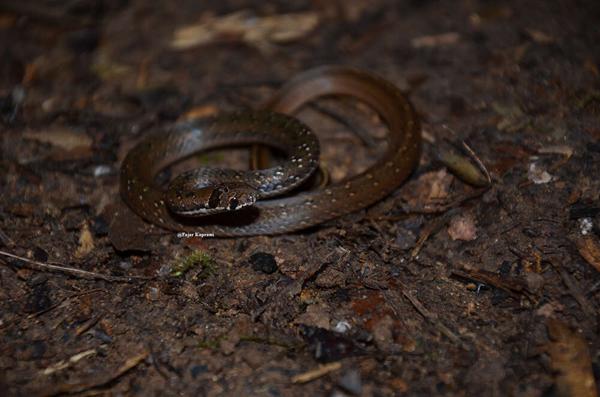
Bleek's Kukri Snake
Oligodon waandersi
Global Distribution
Where this species is recorded worldwide. Restricted to human observations from 2019 onwards — the same kind of record and the same period the probabilities on this page are built from, so collar-tracking studies, camera-trap arrays and museum specimens are excluded. Around Santa Rosa that removes 5,924 GPS fixes from a handful of tagged jaguars.
where this species is recorded (GBIF density — it tracks where observers go, not how likely a sighting is) · parks where it occurs — tap a pin for the sighting probability there
Parks Where Found
| # | Park | Country | Daily sighting probability |
|---|---|---|---|
| 1 | Kinabalu Park | 🇲🇾 Malaysia | |
| 2 | Kinabatangan Wildlife Sanctuary | 🇲🇾 Malaysia | |
| 3 | Sepilok | 🇲🇾 Malaysia | |
| 4 | Tanjung Puting National Park | 🇮🇩 Indonesia | |
| 5 | Danum Valley Conservation Area | 🇲🇾 Malaysia | |
| 6 | Tangkoko Nature Reserve | 🇮🇩 Indonesia |