


Grey-tailed Tattler
Tringa brevipes
- KingdomAnimalia (Animals)
- PhylumChordata (Chordates)
- ClassAves (Birds)
- OrderCharadriiformes (Shorebirds and Allies)
- FamilyScolopacidae (Sandpipers and Allies)
- GenusTringa (Shanks, Tattlers, and Allies)
- SpeciesTringa brevipes (Grey-tailed Tattler)
About the Grey-tailed Tattler
The grey-tailed tattler (Tringa brevipes), also known as the Siberian tattler or Polynesian tattler, is a small shorebird in the genus Tringa. The English name for the tattlers refers to their noisy call. The genus name Tringa is the Neo-Latin name given to the green sandpiper by Aldrovandus in 1599 based on Ancient Greek trungas, a thrush-sized, white-rumped, tail-bobbing wading bird mentioned by Aristotle. The specific brevipes is from Latin brevis, "short", and pes, "foot".
This tattler breeds in northeast Siberia. After breeding, they migrate to an area from southeast Asia to Australia. The grey-tailed tattler is closely related to its North American counterpart, the wandering tattler (T. incana) and is difficult to distinguish from that species. Both tattlers are unique among the species of Tringa for having unpatterned, greyish wings and back, and a scaly breast pattern extending more or less onto the belly in breeding plumage, in which both also have a rather prominent supercilium.
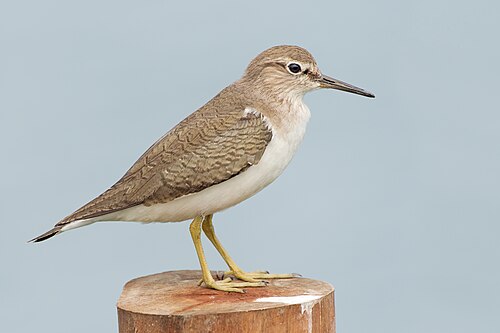
These birds resemble common redshanks in shape and size. The upper parts, underwings, face and neck are grey, and the belly is white. They have short yellowish legs and a bill with... Wikipedia →
Closest Relatives at Tangkoko Nature Reserve

Common Redshank
Tringa totanus
Common Sandpiper
Actitis hypoleucos

Whimbrel
Numenius phaeopus

Black-naped Tern
Sterna sumatrana

Whiskered Tern
Chlidonias hybrida

Kentish Plover
Charadrius alexandrinus

White-winged Tern
Chlidonias leucopterus

Common Tern
Sterna hirundo

Little Tern
Sternula albifrons

Beach Thick-knee
Esacus magnirostris

Barred Buttonquail
Turnix suscitator

White-headed Stilt
Himantopus leucocephalus
Global Distribution
Where this species is recorded worldwide. Restricted to human observations from 2019 onwards — the same kind of record and the same period the probabilities on this page are built from, so collar-tracking studies, camera-trap arrays and museum specimens are excluded. Around Santa Rosa that removes 5,924 GPS fixes from a handful of tagged jaguars.
where this species is recorded (GBIF density — it tracks where observers go, not how likely a sighting is) · parks where it occurs — tap a pin for the sighting probability there
Parks Where Found
| # | Park | Country | Daily sighting probability |
|---|---|---|---|
| 1 | Cape Range | 🇦🇺 Australia | |
| 2 | Ningaloo Marine Park | 🇦🇺 Australia | |
| 3 | Raja Ampat | 🇮🇩 Indonesia | |
| 4 | Everglades National Park | 🇺🇸 United States | |
| 5 | Daintree National Park | 🇦🇺 Australia | |
| 6 | Bali Barat National Park | 🇮🇩 Indonesia | |
| 7 | Taroko National Park | 🇹🇼 Taiwan | |
| 8 | Royal National Park | 🇦🇺 Australia | |
| 9 | Tangkoko Nature Reserve | 🇮🇩 Indonesia | |
| 10 | Kinabatangan Wildlife Sanctuary | 🇲🇾 Malaysia |