
Red-backed Buttonquail
Turnix maculosus
- KingdomAnimalia (Animals)
- PhylumChordata (Chordates)
- ClassAves (Birds)
- OrderCharadriiformes (Shorebirds and Allies)
- FamilyTurnicidae (Buttonquails)
- GenusTurnix (Buttonquail)
- SpeciesTurnix maculosus (Red-backed Buttonquail)
About the Red-backed Buttonquail
The red-backed buttonquail (Turnix maculosus) is a species of bird in the family Turnicidae. It is found in Australia, Indonesia, Papua New Guinea, the Philippines and the Solomon Islands. Other names by which it is known in different parts of its range include black-backed, black-spotted and orange-breasted buttonquail. There are fourteen recognised subspecies.
The red-backed buttonquail is a small stocky bird with round-tipped wings and a short tail. The length varies between 12 and 16 cm (4.7 and 6.3 in). The female is larger than the male and weighs between 32 and 51 g (1.1 and 1.8 oz) to the male's 23 to 39 g (0.8 to 1.4 oz). The subspecies T. m. melanotus, found in northern Australia, has a pale yellow beak, yellowish irises and yellowish legs and feet. The front and top of the head are blackish scalloped with grey, and the side of the head, the neck and throat are brownish-buff, with a reddish-brown partial collar. The upper parts are slate grey, narrowly barred with reddish-brown and black. The under-wing plumage is pale grey. The lower throat is whitish, darkening to buff on the breast and belly, the sides being boldly marked with spots and scallops. The sexes... Wikipedia →
Closest Relatives at Tangkoko Nature Reserve

Barred Buttonquail
Turnix suscitator
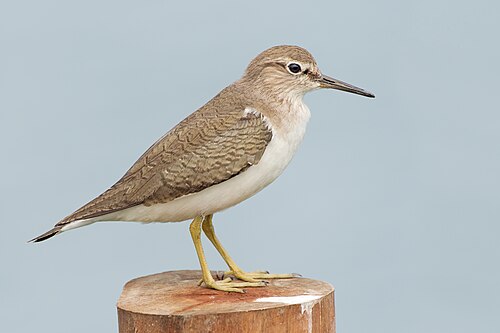
Common Sandpiper
Actitis hypoleucos

Black-naped Tern
Sterna sumatrana

Whiskered Tern
Chlidonias hybrida

Kentish Plover
Charadrius alexandrinus

Whimbrel
Numenius phaeopus

White-winged Tern
Chlidonias leucopterus

Common Tern
Sterna hirundo

Little Tern
Sternula albifrons

Beach Thick-knee
Esacus magnirostris

White-headed Stilt
Himantopus leucocephalus

Black-bellied Plover
Pluvialis squatarola
Global Distribution
Where this species is recorded worldwide. Restricted to human observations from 2019 onwards — the same kind of record and the same period the probabilities on this page are built from, so collar-tracking studies, camera-trap arrays and museum specimens are excluded. Around Santa Rosa that removes 5,924 GPS fixes from a handful of tagged jaguars.
where this species is recorded (GBIF density — it tracks where observers go, not how likely a sighting is) · parks where it occurs — tap a pin for the sighting probability there
Parks Where Found
| # | Park | Country | Daily sighting probability |
|---|---|---|---|
| 1 | Kakadu National Park | 🇦🇺 Australia | |
| 2 | Royal National Park | 🇦🇺 Australia | |
| 3 | Tangkoko Nature Reserve | 🇮🇩 Indonesia |